
Shopify Plus vs Shopify Advanced: 12 Key Differences for Growing Brands (2026)
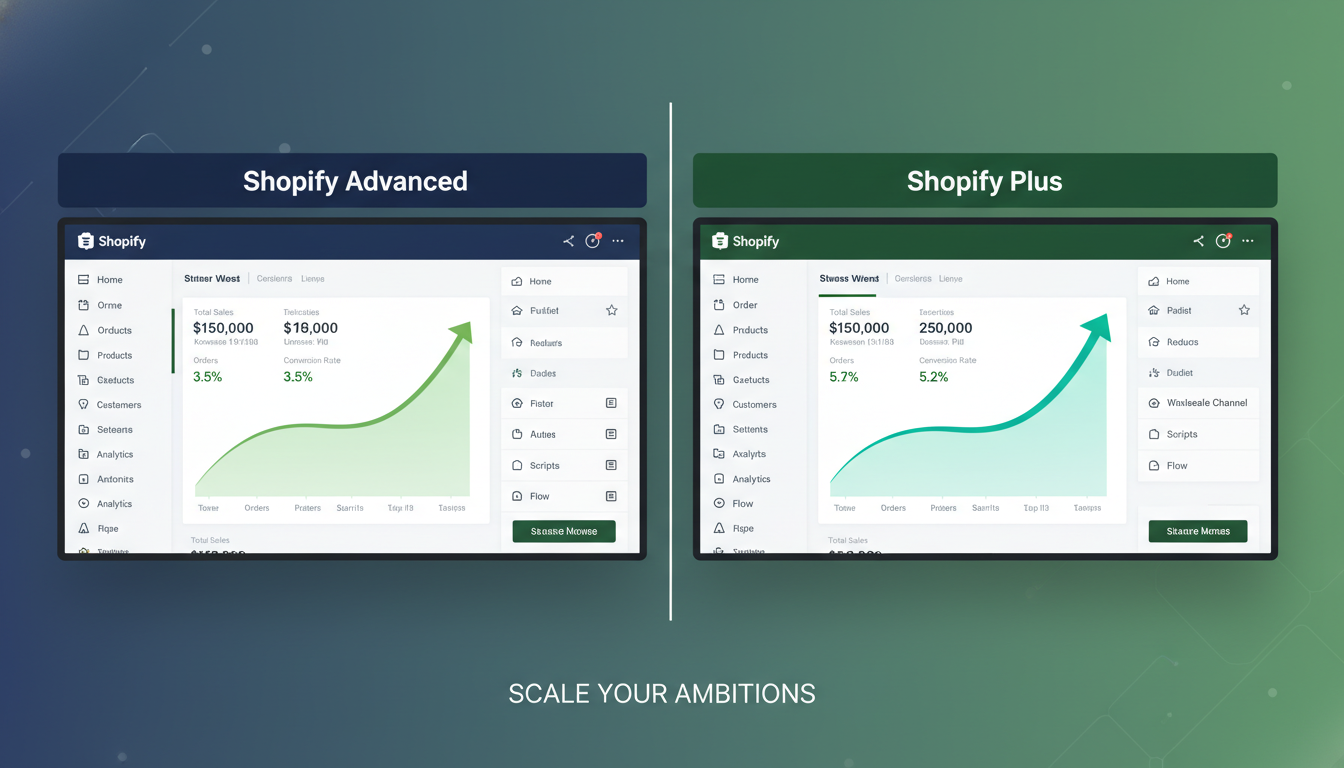
If your Shopify store is clearing $500K/year and you’re staring at an upgrade decision, the choice between Shopify Advanced and Shopify Plus will either unlock your next growth phase or saddle you with $30,000+ in unnecessary annual fees. According to Shopify’s own 2025 Commerce Report, merchants on Plus grow revenue 126% faster on average than those on standard plans — but that number is meaningless if Plus features aren’t aligned with your actual operational bottlenecks.
This guide cuts through the marketing language to give you a direct, feature-by-feature breakdown so you can make the right call before your next billing cycle.
- Shopify Advanced costs $299/month; Shopify Plus starts at $2,300/month — a 7x price difference that demands careful justification.
- Shopify Plus unlocks Shopify Flow automation, Launchpad, B2B features, and up to 10 expansion stores — none of which exist on Advanced.
- Advanced is the right plan for single-market DTC brands doing $500K–$2M/year; Plus is built for complexity — multi-currency, wholesale, high-volume flash sales.
- Transaction fees drop to 0.2% on Plus vs 0.5% on Advanced — at scale, this gap alone can justify the upgrade.
- The Shopify Plus checkout is fully customizable via checkout extensibility; Advanced gets checkout branding but not deep checkout logic customization.
Shopify Advanced vs Shopify Plus: Full Feature Comparison (2026)
Before diving into the nuances, here’s the raw comparison data you need. This table reflects current 2026 pricing and feature sets as of Shopify’s latest plan updates.
| Feature | Shopify Advanced | Shopify Plus |
|---|---|---|
| Monthly Cost | $299/month | From $2,300/month |
| Transaction Fee (non-Shopify Payments) | 0.5% | 0.2% |
| Credit Card Rate (online) | 2.4% + 30¢ | 2.15% + 30¢ (negotiable at volume) |
| Staff Accounts | 15 | Unlimited |
| Stores Included | 1 | Up to 10 expansion stores |
| Shopify Flow (automation) | ❌ | ✅ |
| Launchpad (flash sales scheduler) | ❌ | ✅ |
| B2B / Wholesale Portal | ❌ | ✅ (native) |
| Custom Checkout (checkout extensibility) | Limited branding only | Full customization via checkout UI extensions |
| Checkout.liquid (legacy) | ❌ | ✅ (being phased out) |
| Advanced Report Builder | ✅ | ✅ (plus custom automation) |
| Dedicated Merchant Success Manager | ❌ | ✅ |
| API Rate Limits | Standard | 4x higher API call limits |
| Scripts (discounts, shipping logic) | ❌ | ✅ (Shopify Functions replacing Scripts) |
| Multi-Currency / Markets | ✅ (via Shopify Markets) | ✅ (with more localization controls) |
| SLA / Uptime Guarantee | Standard | 99.98% uptime SLA |
What is the Difference Between Shopify Plus and Shopify Advanced?
The most important thing to understand is that Shopify Advanced and Shopify Plus are not just different tiers of the same thing — they’re built for fundamentally different operational profiles.
Shopify Advanced is the top tier of Shopify’s self-serve commercial plans. It gives you everything in the Basic and Shopify plans, plus advanced reporting, third-party calculated shipping rates, and 15 staff accounts. It’s a capable plan for single-storefront DTC brands that have outgrown the mid-tier but don’t yet need enterprise-grade tooling.
Shopify Plus is Shopify’s enterprise platform. It’s not just a more expensive plan — it’s a fundamentally different product with infrastructure, automation, and organizational tools that don’t exist anywhere on the commercial plan stack. The headline differences that matter most to growing brands are:
1. Checkout Customization
On Shopify Advanced, you can adjust checkout branding — logo, colors, fonts — via Online Store → Themes → Customize → Checkout. That’s it. On Shopify Plus, you get full access to checkout extensibility, which lets you add custom UI extensions: upsell blocks, loyalty points displays, custom form fields, post-purchase pages, and complex conditional logic via Shopify Functions. If your checkout conversion rate is a priority (and it should be — Baymard Institute’s 2025 research puts average checkout abandonment at 70.19%), this difference alone can justify the upgrade at sufficient volume.
2. Shopify Flow Automation
Shopify Flow is a no-code automation builder exclusive to Plus. You can build workflows like: “When an order exceeds $500 AND the customer tag is ‘wholesale,’ auto-apply a 10% discount and send a Slack notification to the fulfillment team.” These automations connect natively to Klaviyo, Gorgias, Yotpo, and dozens of other apps. On Advanced, you replicate this patchwork with third-party tools and manual processes — which costs you operational hours and introduces error risk.
3. B2B and Wholesale
Shopify Plus includes a native B2B portal that lets you set company-level pricing, net payment terms (Net 30, Net 60), and draft orders at scale. On Advanced, building a wholesale channel means either a separate password-protected storefront (clunky) or a third-party app like Wholesale Club or Handshake. If you’re doing any B2B volume, this native functionality is a significant operational advantage.
4. Expansion Stores
Plus merchants get up to 10 expansion stores on the base contract — typically used for international storefronts, brand sub-stores, or a dedicated wholesale store. Each expansion store is a full Shopify store. On Advanced, each additional store is a separate subscription at full price.
5. Transaction Fee Savings
If you use a third-party payment gateway (not Shopify Payments), Advanced charges 0.5% per transaction. Plus drops that to 0.2%. On $5M/year in revenue, that’s a $15,000 annual difference — more than 6 months of the cost gap between the two plans.
What is the Shopify Advanced Plan?
Shopify Advanced is the $299/month plan sitting just below Shopify Plus in Shopify’s commercial tier structure. It’s marketed toward established stores that need more robust reporting and shipping customization than the mid-tier Shopify plan provides.
Here’s what you actually get with Shopify Advanced that you don’t have on lower tiers:
- Advanced report builder: Lets you create custom reports in Shopify Analytics, filtering by any combination of sales channel, product, customer segment, or date range. This is genuinely useful and removes the need to export to Google Sheets for every analysis.
- Third-party calculated shipping rates at checkout: You can surface real-time rates from UPS, FedEx, DHL, and other carriers directly in your checkout. This is critical if your products have variable weight/dimensions that make flat-rate shipping unworkable.
- 15 staff accounts: Up from 5 on the mid-tier plan. For brands with operations, customer service, and marketing teams, this matters.
- Lower credit card processing rates: At 2.4% + 30¢ online vs 2.6% + 30¢ on the Shopify plan, Advanced saves roughly $200 per $100K in online revenue compared to the mid-tier.
- Up to 1,000 inventory locations: Same as Plus — this is relevant if you run multiple warehouses or retail locations.
What Advanced does not give you: automation, B2B, custom checkout logic, multi-storefront management, Launchpad, or the dedicated support infrastructure of Plus. For brands running a clean, single-market DTC operation without complex discount logic or wholesale requirements, Advanced hits a strong value-to-cost ratio.
To upgrade to Advanced: navigate to Settings → Plan → Compare Plans → Select Advanced in your Shopify Admin. Changes take effect immediately and you’re billed pro-rata for the remainder of your billing cycle.
What is the Difference Between Shopify and Shopify Plus?
When people ask this question, they’re usually comparing the mid-tier “Shopify” commercial plan ($79/month) against Shopify Plus ($2,300+/month). The gap is enormous — and not just in price.
The mid-tier Shopify plan is a capable starting point for brands in their first $100K–$500K phase. You get 5 staff accounts, standard reporting, Shopify Payments, and access to the full app ecosystem. It’s where most DTC brands live when they’re finding product-market fit and building their first real marketing playbook.
Shopify Plus, by contrast, is an enterprise platform with an entirely different support structure, infrastructure ceiling, and feature set. Here are the most operationally significant differences:
Infrastructure and Scale
Shopify’s standard plans share infrastructure. During peak traffic events — Black Friday, viral social moments, major ad campaigns — this can create latency issues if Shopify’s shared infrastructure is under load. Shopify Plus runs on dedicated infrastructure with a 99.98% uptime SLA, meaning Shopify is contractually accountable to your uptime in a way they simply aren’t on commercial plans. For brands running flash sales or heavy paid media days, this matters enormously.
Support Model
On the standard Shopify plan, support is ticket-based. Response times during peak periods can stretch hours. Shopify Plus assigns you a dedicated Merchant Success Manager — a named human who knows your account, your tech stack, and your roadmap. When something breaks during a major campaign, that relationship is worth more than any feature.
Customization Ceiling
The mid-tier Shopify plan lets you work within themes and apps. Shopify Plus opens the entire stack: checkout UI extensions, Shopify Functions (custom discount logic, shipping logic, payment customization), and higher API rate limits (4x higher than standard plans). If you’re building custom integrations with an ERP like NetSuite, a PIM like Akeneo, or a 3PL’s warehouse management system, you’ll hit the API limits on standard plans faster than you expect.
Organizational Tooling
Shopify Plus includes the Plus organization admin — a single dashboard to manage all your expansion stores, user permissions, and automation workflows across your entire brand portfolio. On the standard Shopify plan, every store is a completely separate login and admin. For brands operating multiple storefronts, this consolidated view alone eliminates hours of weekly management overhead.
Cost Crossover Point
The raw math: Shopify Plus starts at $2,300/month vs $79/month for the standard Shopify plan — a $26,664/year difference. The transaction fee savings (0.2% on Plus vs 1% on mid-tier Shopify for third-party gateways) mean the break-even on Plus purely from fees is roughly $3.3M in annual revenue processed through a third-party gateway. Realistically, brands should consider Plus when they’re approaching $2M+ in revenue and starting to hit operational complexity that free/cheap apps can’t solve cleanly.
Is Advanced Shopify Worth It?
Yes — but only under specific conditions. Shopify Advanced is worth the $299/month if at least one of the following is true for your store:
When Advanced Is Clearly Worth It
- You’re processing $400K+ annually online and using Shopify Payments. The lower credit card rate (2.4% vs 2.6%) saves you roughly $800/year per $400K in revenue. At $600K+ it fully covers the plan cost differential over the Shopify mid-tier.
- You need real-time carrier-calculated shipping rates. If you’re shipping heavy, irregular, or high-value items where flat-rate pricing either loses you money or kills conversions, this feature alone justifies Advanced. Trying to replicate it with apps on lower tiers adds friction and often inaccuracy.
- You have a team of 6–15 people who need Shopify Admin access. The mid-tier plan’s 5-staff-account limit creates access management problems fast as your team grows.
- You’re making data-driven decisions and need custom reporting. The Advanced report builder integrated with Google Analytics 4 (GA4) gives you the segmentation to answer real business questions — like “what’s the average order value of customers acquired via Meta vs Google in Q4?” — without exporting raw CSV data.
When Advanced Is Not Worth It
- You’re under $300K/year in revenue. The cost differential between Shopify and Advanced ($220/month) won’t be offset by fee savings or operational gains at that volume.
- You’re about to hit Plus-tier complexity anyway. If you’re at $1.8M and scaling fast, spending 6 months on Advanced before upgrading to Plus means paying for both transitions within a year. Jump straight to Plus and start building the automation stack sooner.
- You’re using Shopify Payments and have a small team. The lower transaction fee advantage disappears, and if you have 4 or fewer staff, the accounts upgrade doesn’t help you either.
The Tool Stack That Makes Advanced Genuinely Powerful
Advanced on its own is a clean plan. Paired with the right tools, it punches closer to Plus in practice. The stack that makes the most sense at the Advanced tier:
- Klaviyo — email/SMS automation that replaces some (not all) of what Shopify Flow does on Plus
- Rebuy — product recommendations and cart upsells that add the post-purchase revenue logic you can’t build natively on Advanced
- Hotjar — session recordings and heatmaps to identify checkout friction points you’d otherwise only address with Plus-level checkout customization
- Google Analytics 4 (GA4) — paired with the Advanced report builder, gives you a full-funnel attribution picture
- PageSpeed Insights — monitor Core Web Vitals regularly; Advanced doesn’t give you dedicated infrastructure, so theme performance management is entirely on you
- Okendo — reviews and UGC that improve conversion without requiring checkout-level customization
12 Tactical Factors to Guide Your Shopify Plan Decision
Use this framework to move from “I think I need Plus” to “Here’s why Plus is the right call this quarter.”
- Revenue run rate: Under $1M → Advanced. $1M–$2M → evaluate complexity. Over $2M → strong Plus candidate.
- Transaction volume on third-party gateways: Calculate your annual fee savings at 0.3% difference (Advanced vs Plus). If it approaches $2,000+, put that into your Plus ROI model.
- Checkout conversion rate: If your checkout-to-purchase rate is below 60%, and Hotjar session recordings show friction at specific checkout steps, Plus-level checkout customization via UI extensions is a direct revenue lever. A 1% checkout conversion lift on $3M GMV is $30,000 in incremental revenue.
- B2B or wholesale revenue: Any meaningful B2B channel makes Plus’s native B2B portal a strong justification. Third-party wholesale apps on Advanced typically cost $50–$200/month and lack the depth of native functionality.
- Multi-storefront needs: If you operate or plan to operate more than one Shopify store (regional markets, brand sub-stores, DTC + wholesale), Plus’s expansion stores make financial sense the moment you’d be paying for two separate Advanced subscriptions.
- Flash sale and high-traffic events: Launchpad on Plus lets you schedule price changes, theme changes, and inventory releases down to the minute. On Advanced, this is a manual, error-prone process.
- Automation complexity: Count the manual workflows your ops team runs weekly. If it’s more than 10, Shopify Flow on Plus pays for itself in labor hours within months.
- API integration requirements: If your dev team is building custom integrations with ERPs, OMS platforms, or data warehouses, check whether you’re hitting Shopify’s REST or GraphQL API rate limits. Plus’s 4x rate limit is a technical requirement, not a luxury, at a certain integration complexity.
- Staff accounts: Advanced caps at 15. Plus is unlimited. If you’re a team of 20+ with granular role permissions across multiple store functions, this becomes a daily friction point on Advanced.
- Custom discount logic: Shopify Functions on Plus lets you build discount rules that don’t exist natively — tiered volume discounts, BOGO with exclusions, subscription-aware pricing. Replicating this on Advanced requires third-party apps that can conflict with each other and add checkout latency.
- Dedicated support needs: If you’ve had incidents where a missing support escalation cost you revenue — during a sale event, a payment gateway issue, a theme bug during a campaign — the Plus Merchant Success Manager model is a risk mitigation cost, not just a support upgrade.
- International expansion: Both plans support Shopify Markets for multi-currency and localization. But Plus gives you deeper control over market-specific storefronts, duties/taxes management, and localized checkout experiences that are critical when you’re moving beyond a primary market.
Shopify Plus vs Shopify Advanced: Which Plan Wins for Growing Brands?
There is no universal answer — but there is a framework that works for most brands in the $500K–$5M range.
Choose Shopify Advanced if: You’re a single-market DTC brand, you have a clean tech stack, you’re not doing B2B, and your primary growth levers are marketing performance, product development, and customer retention. Advanced gives you professional-grade reporting and shipping tools at a price point that doesn’t strain your operating margin.
Choose Shopify Plus if: You’re approaching $2M+ in revenue, you’re operating in multiple markets, you have a wholesale channel, your team is manually managing automations that should be systematized, or your checkout conversion rate has meaningful room for improvement that requires custom logic. At this level, the investment in Plus should be modeled as infrastructure spend — not a subscription upgrade.
One more thing worth saying directly: the most expensive mistake growing brands make is staying on Advanced too long. The operational debt — manual processes, workaround apps, constrained checkout customization — compounds quietly. By the time it becomes a visible problem, you’ve already left revenue on the table. Run the numbers quarterly, not annually, and make the upgrade when the ROI model works — not when the pain becomes unbearable.
Whether you’re dialing in your Advanced plan setup or preparing a business case for the Plus upgrade, the decision framework is the same: match your plan to your operational complexity, calculate the real fee economics, and build your tech stack around the native capabilities of whichever tier you’re on.