
Shopify Mobile App Builder Comparison: 7 Best Options for Your Store (2026)
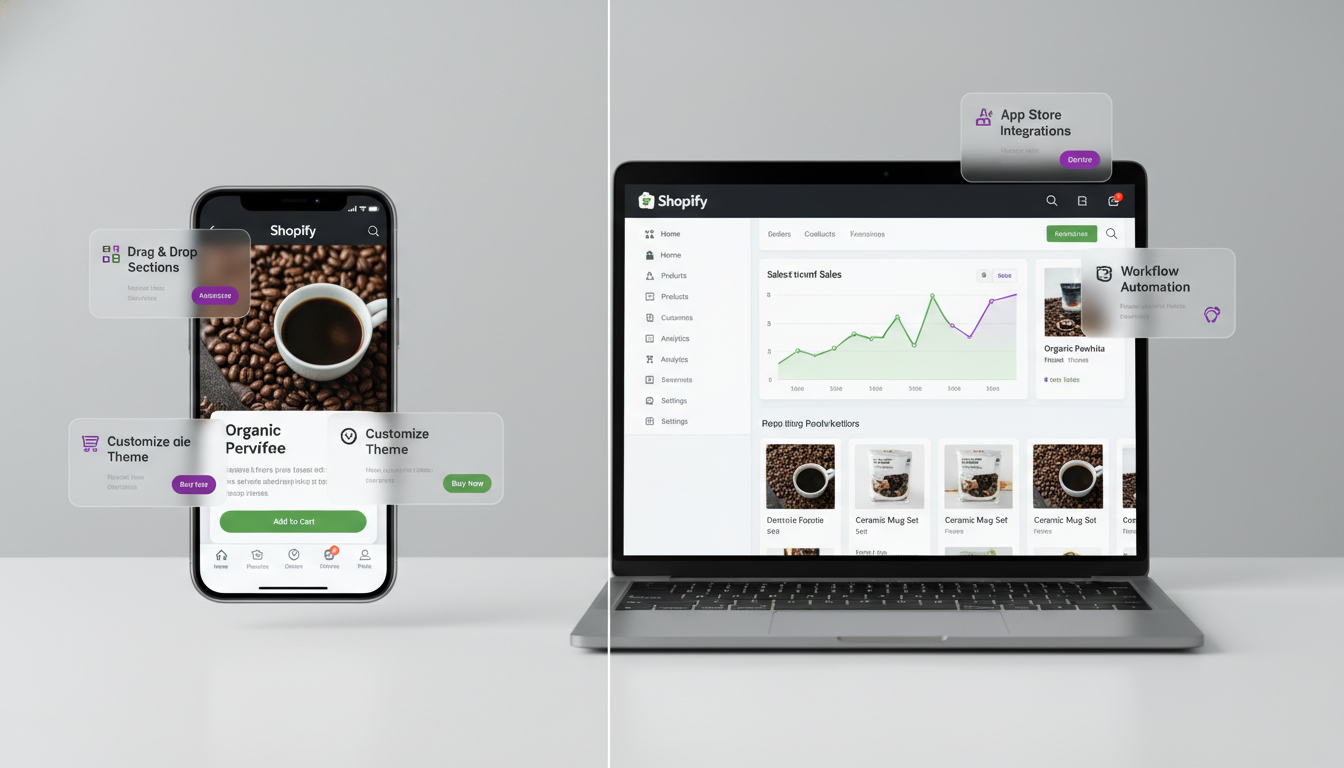
Your Shopify store is leaving money on the table if it only lives in a browser. Mobile commerce accounts for 73% of all global e-commerce sales in 2026 (Statista), yet most Shopify merchants are still serving mobile shoppers through a responsive theme instead of a dedicated native app. The gap between a mobile web experience and a native iOS/Android app — in terms of push notification opt-ins, checkout speed, and repeat purchase rates — is not marginal. It’s structural.
Choosing the right Shopify mobile app builder comes down to your revenue tier, your technical resources, and how much control you need over the customer experience. This guide compares every serious option available in 2026, from no-code app builders to full custom Shopify mobile app development, so you can make the right call for your store.
- No-code Shopify mobile app builders like Vajro and Tapcart can get you live in under two weeks — but come with hard ceiling limitations.
- Custom Shopify mobile app development gives you full control but costs $25,000–$150,000+ and takes 3–6 months.
- Stores doing $500K+/year in revenue typically see positive ROI from a dedicated mobile app within 6–9 months.
- Push notifications from a native app convert at 4–7x the rate of email for re-engagement campaigns.
- The right choice depends on three variables: current revenue, team technical capacity, and customer lifetime value (LTV).
Why a Dedicated Mobile App Outperforms Mobile Web for Shopify Stores
Before comparing builders, you need to understand what you’re actually buying. A native mobile app is not a faster version of your Shopify theme. It’s a fundamentally different surface with different capabilities.
Native apps have access to device features — camera, biometrics (Face ID / fingerprint login), push notifications at the OS level, and offline caching — that a browser-based storefront simply cannot replicate. Shopify merchants who launch a dedicated mobile app report 3–5x higher conversion rates compared to their mobile web store, according to data aggregated by Tapcart across 1,000+ merchant accounts in 2025.
The business case also holds up on engagement. Push notification open rates average 20–30%, versus 2–5% for email (CleverTap, 2025). When you can re-engage a lapsed customer with a single tap notification that opens directly inside your app’s checkout, the funnel collapses from five steps to two.
The Three Paths to a Shopify Mobile App
- No-code app builders — drag-and-drop platforms that sync with your Shopify store via API. Low cost, fast launch, limited customization.
- Low-code / hybrid builders — platforms offering more flexibility through custom component blocks or developer APIs. Mid-range cost, more extensibility.
- Custom Shopify mobile app development — bespoke iOS/Android apps built on React Native, Flutter, or Swift/Kotlin. Maximum control, highest cost and timeline.
The 7 Best Shopify Mobile App Builders Compared (2026)
Here’s the full comparison matrix. All pricing is monthly unless noted as one-time or project-based.
| Platform | Type | Starting Price | Best For | Push Notifications | Custom Dev API | Time to Launch |
|---|---|---|---|---|---|---|
| Vajro | No-code | $99/mo | SMB stores, quick launch | ✅ Unlimited | Limited | 1–2 weeks |
| Tapcart | No-code / Low-code | $200/mo | Growing DTC brands | ✅ Unlimited | Custom Blocks SDK | 1–3 weeks |
| Plobal Apps | No-code | $149/mo | Mid-market stores | ✅ Unlimited | Limited | 1–2 weeks |
| Appbrew | Low-code | $499/mo | $1M+ revenue brands | ✅ Advanced segmentation | Yes | 2–4 weeks |
| MageNative | No-code | $49/mo | Budget-conscious stores | ✅ Basic | No | 1 week |
| Shopney | No-code | $149/mo | Fashion & lifestyle brands | ✅ Unlimited | Limited | 1–2 weeks |
| Custom Development | Bespoke | $25K–$150K+ (project) | $2M+ revenue, complex UX | ✅ Fully custom | Full control | 3–6 months |
Shopify Mobile App Builder by Vajro: A Closer Look
Vajro is one of the longest-standing no-code Shopify mobile app builders on the market, with over 5,000 active stores using the platform as of early 2026. Its core strength is speed — you can have a functional iOS and Android app live on the App Store and Google Play within 7–14 days without writing a single line of code.
The setup flow mirrors your existing Shopify store: Vajro pulls your product catalog, collections, and customer data directly through the Shopify Storefront API. Your existing Shopify discounts, metafields, and Shopify Markets configurations carry over automatically.
Where Vajro Works Well
- Stores with a straightforward catalog structure (no complex bundles or subscription logic)
- Merchants who want to run live video shopping events natively inside the app
- Teams without an in-house developer who need to manage everything through a visual editor
Where Vajro Falls Short
- Custom checkout flows (e.g., Rebuy-powered upsells, multi-step subscription onboarding) are not fully supported
- Deep integrations with Klaviyo for in-app event triggers require workarounds
- The app’s design customization ceiling is lower than Tapcart or Appbrew
At $99/month on the base plan, Vajro is hard to beat for stores doing under $500K/year that want to test the mobile app channel without a large upfront commitment.
Tapcart vs Vajro: Which No-Code Builder Wins in 2026?
This is the comparison most Shopify merchants end up making. Tapcart has positioned itself as the premium no-code builder, and the price difference ($200/mo vs $99/mo at entry) reflects real differences in capability.
Tapcart’s most significant advantage is its Custom Blocks SDK, which lets developers inject React-based custom components into the app without building the entire thing from scratch. This means you can use Tapcart as the app shell and still power specific screens — a loyalty dashboard, a Rebuy upsell drawer, or a custom AR try-on feature — with bespoke code.
Tapcart also has tighter native integrations with Klaviyo, Yotpo, Okendo, and Gorgias than any other no-code builder on this list. Stores using Tapcart’s Klaviyo integration report a 22% increase in SMS + push revenue per recipient compared to web-only Klaviyo flows (Tapcart 2025 Benchmark Report).
If your store is above $500K/year in revenue, has a Klaviyo email/SMS program already running, and wants the most capable no-code option available, Tapcart is the correct choice. If you’re earlier stage or want live selling features, Vajro wins on value.
When to Choose Custom Shopify Mobile App Development Instead
No-code builders are compelling, but they have a hard ceiling. The moment you need any of the following, you’re beyond what Vajro, Tapcart, or any other builder can give you:
- A fully custom checkout experience using Shopify’s Checkout Extensibility APIs
- Augmented reality (AR) product visualization powered by your own 3D model pipeline
- Complex membership or subscription tier logic with dynamic pricing rules
- Deep integration with an ERP, WMS, or custom PIM system
- White-labeled B2B ordering apps with company-specific catalogs and net terms
Custom Shopify mobile app development — whether built in React Native (the most common choice for Shopify stores given its JavaScript alignment with the Storefront API) or Flutter — costs between $25,000 and $150,000+ for a full-featured v1, depending on complexity and where the team is based.
Custom Shopify Mobile App Development in India: What to Expect
India has a well-developed Shopify development ecosystem, and many high-quality agencies and freelance teams specialize in React Native and Flutter app builds for Shopify merchants. Hourly rates range from $25–$60/hour for senior developers, compared to $100–$200/hour in the US or UK.
A comparable app that costs $80,000 with a North American agency might cost $30,000–$45,000 with a vetted Indian development partner. The tradeoff is timezone overlap for real-time collaboration, and you’ll want to verify that the team has specific Shopify Storefront API and Shopify Functions experience — not just general React Native skills.
When vetting any custom development partner, ask for three specific things: a prior Shopify app they’ve built that’s live on the App Store, their approach to Shopify’s Storefront API v2 (the 2024+ version supporting cart transforms and metaobjects), and their testing protocol for checkout edge cases.
How to Connect a Mobile App Builder to Your Shopify Store
For no-code builders like Vajro, Tapcart, and Plobal Apps, the connection process is straightforward. Here are the exact steps for Tapcart as a representative example:
- From your Shopify Admin → Apps → App and sales channel settings, install the Tapcart app from the Shopify App Store.
- Tapcart will request Storefront API access — approve the permission scope for read/write on products, customers, orders, and cart.
- Inside the Tapcart dashboard, go to Design → Home Screen and begin mapping your collection structure to the app’s navigation.
- Under Settings → Notifications, configure your first push notification campaign. Connect Klaviyo under Integrations → Email/SMS → Klaviyo for unified audience syncing.
- Submit to the Apple App Store via Publish → iOS → Submit for Review. Apple review typically takes 24–72 hours for app builder submissions.
- Submit to Google Play under Publish → Android → Google Play Console. Google review is typically 2–7 days for new apps.
Once live, monitor app performance using a combination of the builder’s native analytics dashboard and Google Analytics 4 (configured via Shopify Admin → Online Store → Preferences → Google Analytics). For behavior heatmaps inside the app, Hotjar does not support native apps — use FullStory or Smartlook instead, both of which have Tapcart-compatible SDKs.
Can I Make a Mobile App With Shopify?
Yes — and there are more ways to do it in 2026 than most merchants realize. Shopify itself does not offer a native “build your own app” tool inside the admin, but the Shopify ecosystem provides everything you need to create a fully functional iOS and Android app for your store.
The most accessible route is through a Shopify mobile app builder — a third-party platform (like Vajro, Tapcart, or Plobal Apps) that connects to your store via the Shopify Storefront API and generates a native app from your existing product catalog, collections, and customer data. These builders handle the App Store and Google Play submission process on your behalf, which eliminates the biggest technical barrier for non-developers.
The second route is building a Progressive Web App (PWA). Shopify themes built on the Dawn framework support some PWA capabilities out of the box, including offline caching and a basic “Add to Home Screen” prompt. However, PWAs cannot send OS-level push notifications on iOS (Apple continues to restrict this as of 2026), which is a significant limitation compared to native apps.
The third route is full custom development using Shopify’s Storefront API, the Customer Account API, and the Checkout Sheet Kit — a Shopify-maintained SDK that embeds Shopify’s native checkout inside a React Native or Flutter app. This approach gives you complete design and UX control while keeping Shopify as the commerce backend.
Which route is right for you? Stores under $300K/year should start with a no-code builder and test the channel before investing more. Stores doing $1M+ with a strong customer retention program should evaluate Tapcart or Appbrew at minimum, and consider custom development if the app needs to handle business logic that a builder can’t support. The cost of doing nothing — losing repeat purchases to competitors who do have a dedicated app — compounds every quarter.
What Is the Mobile App Builder for Shopify Store?
A mobile app builder for a Shopify store is a SaaS platform that uses Shopify’s Storefront API to turn your existing store data — products, collections, customer accounts, discount codes, and order history — into a native iOS and Android app without requiring custom code.
These platforms work by acting as a presentation layer on top of Shopify’s commerce infrastructure. Your inventory, pricing, and checkout logic all still live inside Shopify. The app builder handles the mobile UI, the push notification engine, the App Store listings, and the over-the-air content updates (meaning you can change your app’s homepage banner without resubmitting to Apple).
The best Shopify mobile app builders in 2026 share several key capabilities:
- Real-time product sync — inventory updates in Shopify reflect in the app within seconds, not hours
- Deep link support — marketing emails and SMS messages (sent via Klaviyo) can open directly to specific product or collection pages inside the app
- Shopify Payments and Shop Pay compatibility — no re-entering card details; Shop Pay’s accelerated checkout works natively
- Loyalty and reviews integration — connections to platforms like Okendo (reviews), Yotpo (loyalty), and LoyaltyLion
- Segmented push notifications — targeting by purchase history, location, browsing behavior, or Klaviyo segment membership
The distinction between builders matters significantly at scale. MageNative and Shopney are adequate for early-stage testing. Tapcart and Appbrew are purpose-built for stores with serious CRM programs and high-frequency customers. The average Tapcart merchant generates $93 in mobile app revenue per push notification send across their installed base (Tapcart, 2025), which is a benchmark worth using to model your own ROI before choosing a plan tier.
When evaluating any builder, request a demo account and test two specific scenarios: (1) how the app handles a product with 50+ variants, and (2) how it renders a Shopify metafield-driven custom product description. These two tests expose the majority of platform limitations before you commit.
Who Is the Highest Earner on Shopify?
The highest-earning Shopify merchant by revenue is Gymshark, the UK-based fitness apparel brand that famously bootstrapped on Shopify before reaching a $1.3 billion valuation. Gymshark processed hundreds of millions in annual revenue through its Shopify store before eventually moving to Shopify Plus and building out a hybrid headless architecture.
Other top earners on Shopify Plus include Allbirds, Skims (Kim Kardashian’s shapewear brand), Kylie Cosmetics, and Heinz (which runs its direct-to-consumer channel on Shopify). Several of these brands generate north of $100 million annually through their Shopify-powered storefronts.
What’s instructive about the highest earners on the platform isn’t just their revenue numbers — it’s how they use mobile. Gymshark has consistently reported that 70%+ of its traffic is mobile, and its investment in a custom-built native app (not an off-the-shelf builder) was a deliberate decision tied to customer lifetime value. When your average customer buys 4–6 times per year, a 2-second faster checkout and an app-exclusive flash sale push notification have compounding revenue impact.
The pattern among Shopify’s top earners is consistent: they treat mobile as a dedicated channel with its own acquisition budget, retention strategy, and technical investment — not as a checkbox. Brands like Skims use their native app to run exclusive early-access drops that drive app installs through scarcity, then monetize those installs through a push notification calendar built on top of their Klaviyo segmentation data.
For merchants at $500K–$5M/year, the lesson isn’t to copy a $100M brand’s tech stack — it’s to adopt the mindset that mobile is a retention channel, not just a traffic source. Even a $200/month Tapcart subscription, used intelligently with weekly segmented push campaigns, can recover enough lapsed customers to generate 5–10x ROI within a quarter.
Will AI Replace Shopify Developers?
No — but AI is definitively changing what Shopify developers spend their time on, and it’s raising the floor of what a non-developer can accomplish. This is especially relevant in the mobile app context, where AI tools are collapsing timelines and reducing certain categories of development cost.
In 2026, AI coding assistants like GitHub Copilot, Cursor, and Shopify’s own Sidekick have become standard tools in the workflow of Shopify developers. A React Native developer using Cursor can complete in 2 hours what would have taken 8 hours manually two years ago — particularly for boilerplate work like API integration scaffolding, component library setup, and test case generation.
What AI cannot do — and shows no near-term path to doing — is replace the strategic judgment that experienced Shopify developers bring. Decisions like: should this store use Shopify’s Checkout Sheet Kit or build a custom checkout flow? How should Shopify Functions be used to implement dynamic pricing logic inside a mobile cart? How do you architect a Storefront API caching layer that handles a flash sale with 10,000 concurrent users without rate-limit errors? These are not prompt engineering problems. They require domain expertise built over years of production deployments.
The more practical impact of AI on the Shopify development market is downward pressure on rates for commodity work. Simple Liquid customizations, basic theme modifications, and formulaic app integrations are becoming easier to AI-generate, and clients are right to expect lower quotes for this type of work. Meanwhile, rates for senior Shopify architects — developers who design headless commerce systems, build Shopify app extensions, or lead complex migrations — have remained stable or increased, because demand outpaces supply and AI doesn’t close that gap.
For mobile app development specifically: AI tools have made no-code builders smarter (Tapcart uses AI to suggest push notification copy and send-time optimization), but they haven’t made custom development unnecessary for stores with complex requirements. If anything, faster AI-assisted development means some custom app builds that previously required $80,000 can now be completed for $45,000 — making custom development accessible to a lower revenue tier than before.
Shopify Mobile App Builder vs Custom Development: How to Decide
This is the core decision tree for every Shopify merchant evaluating mobile in 2026. Use these benchmarks to guide your choice:
| Factor | Choose a Builder | Choose Custom Dev |
|---|---|---|
| Annual Revenue | Under $1M | $1M+ (especially $2M+) |
| Time to Market | Need live in under 4 weeks | Can wait 3–6 months |
| Checkout Complexity | Standard Shopify checkout | Custom flows, subscriptions, B2B |
| Design Requirements | Template-based is acceptable | Fully bespoke brand experience |
| In-House Dev Team | No developers on staff | Has or can hire dev resources |
| Budget (upfront) | Under $5,000 upfront | $25,000–$150,000 available |
| Integration Needs | Klaviyo, Okendo, Yotpo (standard) | ERP, custom PIM, AR, bespoke APIs |
| App Store Ownership | Shared/platform-managed | Full ownership of listings |
One factor that often gets overlooked: when you build on a no-code platform, you do not own the App Store listing in the same way a custom app owner does. If a builder shuts down or raises prices dramatically, migrating your installed user base to a new app is painful — users must download a new app, re-authenticate, and opt back into push notifications. Custom development gives you full portability and ownership of that asset.
Shopify Mobile App Builder Free Options: What’s Actually Available
Genuinely free Shopify mobile app builders are rare in 2026, and the few that exist come with significant limitations. MageNative offers a free trial (typically 14 days), as does Shopney. Vajro occasionally runs promotional periods for new merchants on Shopify Basic.
The honest reality is that “free” in this category usually means one of two things: a limited free trial before a paid subscription kicks in, or a free plan that doesn’t include App Store submissions (meaning your app exists only in a preview environment and can never be installed by real customers).
If budget is the primary constraint, the most defensible path is MageNative’s $49/month entry plan, which includes full App Store and Google Play submission, unlimited push notifications, and basic Shopify integration. It is not as capable as Tapcart or Vajro at the feature level, but it is a real, live, customer-facing app for under $600/year.
Before committing to any plan, use each platform’s ROI calculator with conservative assumptions: estimate 10% of your monthly customer base downloads the app, 30% opt into push notifications, and those subscribers convert at 2x your current email conversion rate. Even on those conservative numbers, most stores doing $300K+/year will see payback within 60–90 days on any of the paid plans in this comparison.
Final Assessment: Matching the Right Tool to Your Store’s Stage
The Shopify mobile app builder market in 2026 is mature enough that there’s a credible option at every budget level, and no merchant has a valid reason to skip mobile entirely. The calculus is straightforward: if your customers buy from you more than once per year, a native app with push notifications will increase their purchase frequency. The only question is which investment level makes sense given your current revenue and growth trajectory.
Stores under $300K/year should start with Vajro or MageNative, run a 90-day push notification experiment, and measure app-attributed revenue against subscription cost before upgrading. Stores between $300K and $1M/year should look hard at Tapcart — its Klaviyo integration and Custom Blocks SDK mean you won’t outgrow it quickly. Stores above $1M/year should evaluate Appbrew for a no-code solution, or seriously price a custom React Native build if their checkout or integration requirements exceed what any builder can handle. Custom Shopify mobile app development in India remains the most cost-efficient route to a fully bespoke app, provided you vet the team’s Storefront API experience rigorously.
The worst outcome isn’t picking the wrong builder — it’s spending another year serving your most loyal customers through a mobile browser while your competitors push app-exclusive offers directly to their lock screens.