
Shopify Mobile App Builder Comparison: 7 Best Options for Your Store (2026)
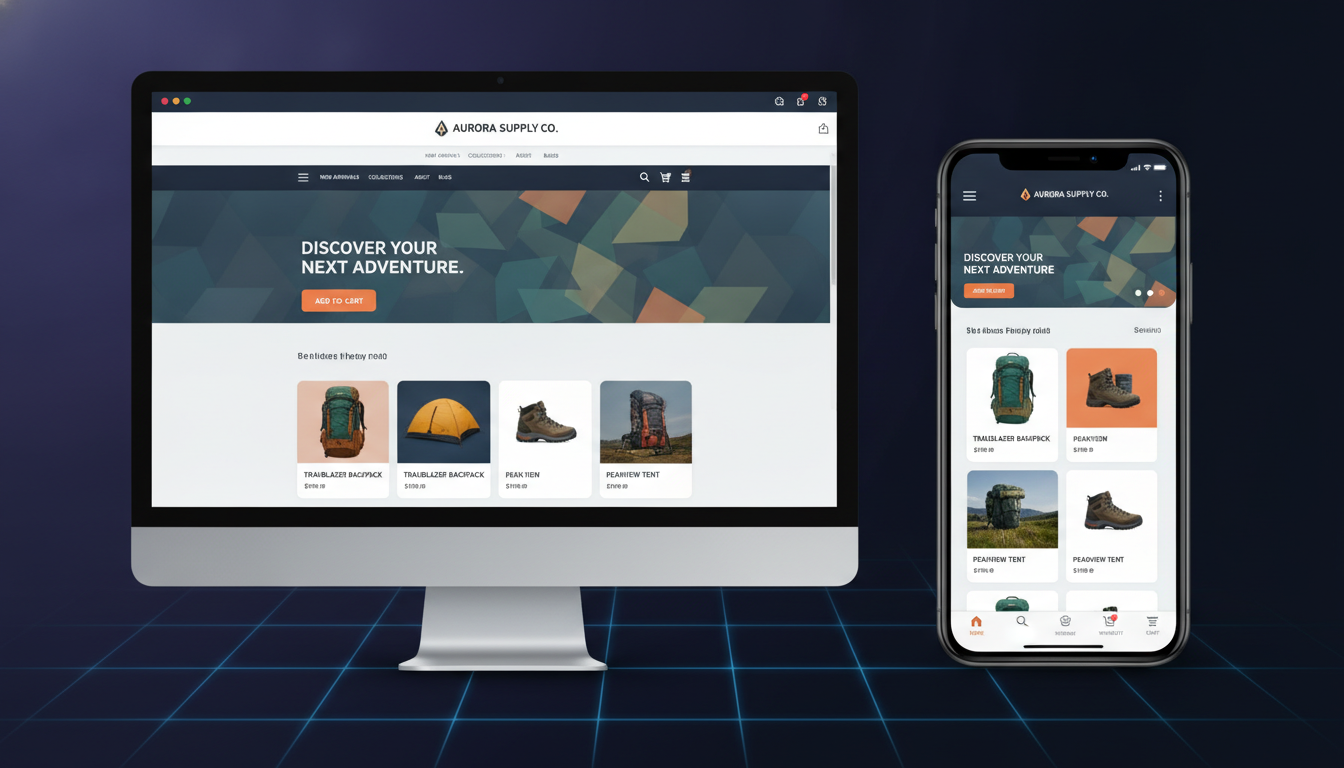
Mobile commerce now accounts for 73% of all global e-commerce sales (Statista, 2025), and your Shopify store’s mobile website is no longer enough to stay competitive. App users convert at 3x the rate of mobile web browsers, have higher average order values, and return far more often. If you’re running a Shopify store doing $50K or more per year, a dedicated mobile app isn’t a vanity project — it’s a revenue channel.
The problem? Choosing between no-code Shopify mobile app builders, low-code platforms, and custom shopify mobile app development is genuinely confusing. Costs range from $0 to $200,000+, and the wrong choice can leave you locked into a platform that doesn’t scale — or bleed budget on development that wasn’t necessary.
This guide cuts through the noise with a direct comparison of every serious option available in 2026.
- No-code Shopify mobile app builders like Vajro and Tapcart can get you live in days — but they come with recurring fees and limited customization ceilings.
- Custom Shopify mobile app development gives you full control but requires $30K–$150K+ upfront and 3–6 months of build time.
- Push notifications from a native app deliver an average open rate of 19.5% vs. 2–3% for email (CleverTap, 2025) — this alone justifies the investment for high-repeat-purchase brands.
- The best mobile app builder for your Shopify store depends on your annual revenue, product catalog complexity, and brand differentiation needs.
- Headless PWA (Progressive Web App) is a middle-ground worth serious consideration for stores between $250K–$1M/year.
The 7 Best Shopify Mobile App Builders Compared
Below is a structured breakdown of the leading platforms. Each has a distinct sweet spot — knowing which one matches your store profile is the entire game.
1. Vajro
Vajro is one of the most widely adopted Shopify mobile app builders, particularly popular among fashion, beauty, and lifestyle brands. Its drag-and-drop builder syncs directly with your Shopify catalog in real time, and setup takes under 48 hours with no developer required. Pricing starts at $99/month for the Core plan, scaling to $299/month for the Elite tier with advanced push notification segmentation and live video shopping.
Vajro’s standout feature is its Facebook Live and Instagram Live integration baked directly into the app experience — useful if your brand already does social selling. The Shopify mobile app builder by Vajro also supports multi-currency, multi-language, and Shopify Markets natively.
2. Tapcart
Tapcart positions itself as the premium end of the no-code spectrum. At $200–$500/month depending on plan, it’s more expensive than competitors but delivers one of the cleanest native app UI frameworks available without writing code. Brands like FEASTABLES and Chubbies run on Tapcart. Its push notification engine integrates directly with Klaviyo, which means your existing segmentation logic applies without rebuilding anything.
Tapcart’s “Instant Commerce” architecture pre-fetches product data so the app feels genuinely fast — a critical conversion variable. PageSpeed Insights won’t score your app directly, but internal Tapcart benchmarks show median first-interaction times under 300ms.
3. Plobal Apps
Plobal Apps is the strongest contender for stores that need deep Shopify Plus integrations — loyalty programs, subscriptions via Recharge, and complex discount stacking. Their white-glove onboarding and dedicated account manager model makes them worth the $149–$499/month price range if you’re operating above $1M/year and don’t have in-house mobile expertise.
Plobal’s analytics dashboard is notably superior to Vajro’s default reporting, giving you cohort-level retention data and revenue-per-push-notification metrics that matter for decision making.
4. MageNative
MageNative is a strong budget-tier option, with plans starting at $49/month. It supports both Android and iOS builds, connects directly to your Shopify store via official API, and includes basic push notification support. The trade-off is a less refined UI framework — app screens feel more generic out of the box, and customization depth is shallower than Vajro or Tapcart.
If you’re a store under $150K/year testing whether an app channel makes sense before committing bigger budget, MageNative is a reasonable starting point.
5. Appbrew
Appbrew emerged as one of the stronger challengers in 2024–2025, particularly for brands that care about CRO inside the app. It offers native integration with Rebuy for personalized product recommendations, Okendo for in-app reviews, and Yotpo for loyalty — the three tools that most meaningfully move conversion rate inside a mobile app. Pricing runs $299–$799/month, putting it at the premium tier alongside Tapcart.
6. Progressive Web App (PWA) via Headless Shopify
A PWA built on a headless Shopify stack (Hydrogen + Oxygen, or Next.js + Shopify Storefront API) isn’t an “app builder” in the traditional sense — it’s a custom-coded solution that behaves like a native app in the browser. Users can add it to their home screen, receive push notifications (via Web Push), and get app-speed loading. Development costs range from $25,000–$80,000 depending on scope, with ongoing maintenance costs.
This is the right path for stores between $500K–$2M/year that want app-like experience without the friction of App Store submission and review cycles.
7. Fully Custom Native App Development
Custom shopify mobile app development — native Swift/Kotlin or React Native — is the most powerful and most expensive route. You’re building iOS and Android apps from scratch, integrating with Shopify’s Storefront API or Admin API, and owning 100% of the codebase. Budget $50,000–$200,000 for a properly scoped v1, plus $5,000–$15,000/month in ongoing development and maintenance.
This path makes sense for stores above $3M/year where app UX differentiation is a core brand strategy, or for stores with highly complex product configurators, B2B buying workflows, or subscription + membership logic that no-code builders simply can’t handle.
Shopify Mobile App Builder Comparison Table
| Platform | Starting Price | Build Type | Time to Launch | Klaviyo Integration | Best For |
|---|---|---|---|---|---|
| Vajro | $99/mo | No-code | 24–48 hrs | ✓ Native | Fashion, lifestyle <$1M/yr |
| Tapcart | $200/mo | No-code | 2–5 days | ✓ Native | DTC brands $500K–$5M/yr |
| Plobal Apps | $149/mo | No-code + managed | 3–7 days | ✓ Via integration | Shopify Plus, $1M+/yr |
| MageNative | $49/mo | No-code | 24–48 hrs | ✗ | Stores testing app channel |
| Appbrew | $299/mo | No-code + CRO | 3–7 days | ✓ Native | CRO-focused DTC brands |
| Headless PWA | $25K–$80K (one-time) | Custom dev | 6–14 weeks | ✓ Custom | $500K–$2M/yr stores |
| Custom Native App | $50K–$200K+ | Fully custom | 3–6 months | ✓ Custom | $3M+/yr, complex UX needs |
Shopify Mobile App Builder vs. Custom Development: Which Actually Wins?
This is the question every serious Shopify merchant asks once they’ve outgrown the “just try it” phase. The honest answer depends on three variables: your annual revenue, your product complexity, and how differentiated your app experience needs to be.
When a No-Code Shopify Mobile App Builder Wins
If your store does under $2M/year, your product catalog is fairly standard, and your team doesn’t include mobile engineers, a no-code builder like Tapcart or Vajro will almost certainly generate a better return than custom development. You’re live in days, push notifications are running within a week, and you’re recouping your $200–$500/month investment with incremental revenue from an engaged app audience.
The math is simple: if your app drives even $5,000/month in incremental revenue from push notification campaigns and repeat purchases, a $300/month platform fee is a 16x return. Most brands report app channel revenue growing to 15–30% of total store revenue within 12 months of launch (Tapcart internal data, 2025).
When Custom Development Wins
Custom shopify mobile app development wins when your product requires a buying experience that no template can replicate — think complex product configurators, B2B quoting workflows, AR try-on, or subscription + membership tiers with conditional logic. It also wins when your brand’s visual identity is so specific that any template-based UI creates friction or brand inconsistency.
Custom development also makes sense if you’re planning to expand beyond Shopify in the next 2–3 years. A React Native app built against Shopify’s Storefront API can be re-platformed far more easily than ripping out a no-code builder’s proprietary infrastructure.
The Hidden Cost of No-Code Lock-In
One risk that’s rarely discussed: no-code Shopify mobile app builders own your app’s infrastructure. If Tapcart changes pricing, gets acquired, or deprecates a feature, you have limited leverage. A custom-built app is an asset on your balance sheet. A SaaS app builder subscription is an operating expense with vendor dependency baked in.
How to Connect Your Shopify Store to a Mobile App Builder
Regardless of which platform you choose, the connection process follows a similar pattern. Here’s the step-by-step process using Shopify’s Admin panel:
- Go to your Shopify Admin → Apps → App and sales channel settings. This is where you’ll manage API access for third-party app builders.
- Navigate to Settings → Apps and sales channels → Develop apps. Enable custom app development if you’re working with a custom developer or a platform that requires API key access.
- Grant the required API scopes. Most no-code builders need:
read_products,read_orders,read_customers,write_checkouts. Never grant broader admin access than the platform specifically requests. - Install the app builder’s Shopify app from the Shopify App Store. For Vajro, Tapcart, Plobal, MageNative, and Appbrew — all are available in the Shopify App Store. Search by name, click Install, and approve permissions.
- Configure your catalog sync. Most builders automatically pull your collections, product tags, and metafields. Map your navigation structure inside the builder’s dashboard — this typically mirrors your Shopify Online Store → Navigation → Main menu structure.
- Set up push notification flows. Connect Klaviyo via the builder’s integration settings. Map your existing Klaviyo segments to push notification audiences so cart abandonment, win-back, and post-purchase flows fire from the app as well as email.
- Submit to App Store and Google Play. This requires an Apple Developer account ($99/year) and a Google Play Developer account ($25 one-time). Most no-code builders handle the submission process on your behalf.
Can You Create a Mobile App With Shopify?
Yes — and there are multiple legitimate routes to do it depending on your technical resources and budget. Shopify does not natively build a mobile app for your storefront; the default Shopify experience on mobile is a responsive mobile website accessed through a browser, not a dedicated iOS or Android application.
To get a true native mobile app for your Shopify store, you have three main options. First, use a no-code Shopify mobile app creator — platforms like Vajro, Tapcart, or Appbrew connect directly to your Shopify store via API and generate native iOS and Android apps from your existing catalog, collections, and checkout flow. These are installed from the Shopify App Store and typically go live in 24–72 hours.
Second, use Shopify’s own Storefront API or Hydrogen framework to build a custom mobile experience. Shopify’s Storefront API is publicly documented and allows developers to build fully custom frontends — including native mobile apps — that pull real-time product, inventory, and checkout data from your Shopify backend. This is what large DTC brands and enterprise retailers use for bespoke app experiences.
Third, you can build a Progressive Web App (PWA) on top of a headless Shopify architecture. A PWA isn’t technically listed in the App Store or Google Play (though it can be wrapped and submitted), but it behaves like a native app — offline capability, push notifications, home screen installation, and app-speed performance. For stores that want app-like UX without the complexity of App Store management, a PWA is a compelling middle-ground.
One important clarification: Shopify’s own mobile app (Shopify App for merchants) is for store management, not customer-facing shopping. Customers do not browse or buy through it. A separate customer-facing app is always required, and that’s precisely what the platforms in this guide help you build.
The strongest ROI case for creating a mobile app with Shopify comes from push notification re-engagement. Brands consistently report push notification open rates of 15–25% — compared to email’s industry average of 21% but with far higher click-through rates of 8–12% vs. email’s 2–3% (CleverTap, 2025). For stores with a high repeat-purchase rate, that incremental re-engagement translates directly to measurable LTV increases.
What Is the Mobile App Builder for Shopify Store?
A mobile app builder for Shopify store is a third-party SaaS platform that converts your existing Shopify store into a downloadable iOS and Android application — without requiring you to write custom code. These platforms connect to your Shopify store via the Shopify API, pull your product catalog, collections, pricing, and checkout logic in real time, and wrap it in a native mobile app framework that gets submitted to the Apple App Store and Google Play Store under your brand name.
The best mobile app builder for Shopify store handles four core functions: catalog sync (products, variants, inventory, pricing update automatically), native checkout (Shopify’s checkout is embedded or replicated natively, supporting Shop Pay, Apple Pay, and Google Pay), push notifications (direct-to-device messaging for promotions, cart recovery, and back-in-stock alerts), and app analytics (session data, conversion rates, and revenue attribution separate from your web store).
The key differentiators between platforms come down to how deeply they integrate with your existing Shopify tech stack. The best options in 2026 connect natively with Klaviyo for email + push unification, Rebuy for in-app personalized recommendations, Okendo or Yotpo for in-app reviews, and Recharge for subscription management. If any of those tools are core to your store’s revenue model, verify integration depth — not just checkbox compatibility — before committing to a platform.
From a technical standpoint, most no-code app builders use React Native or Flutter as their underlying mobile framework. This matters because it affects app performance, animation smoothness, and the ceiling on what custom UI work is possible if you eventually want a developer to extend the platform’s default templates. React Native apps are generally easier to extend with custom modules; proprietary frameworks are harder to break out of.
Pricing across the category ranges from $49/month (MageNative) to $799/month (Appbrew Enterprise), with the median serious option landing around $200–$300/month. All plans require your own Apple Developer and Google Play accounts, which cost $99/year and $25 one-time respectively. Factor those into your total cost of ownership from day one.
Does Shopify Work With Shein?
This question appears frequently in search data, and the direct answer is: Shopify and Shein are not integrated and do not have an official partnership as of 2026. Shein operates as a fully closed, vertically integrated e-commerce platform — it is not a marketplace that third-party Shopify merchants can list products on through a native integration, the way you might connect Shopify to Amazon, Etsy, or TikTok Shop.
Shein’s business model is fundamentally different from a marketplace. It manufactures and sells its own products through its own platform, supply chain, and app. It does not offer a seller program in the traditional sense that would allow a Shopify merchant to sync their catalog and fulfill orders through Shein’s storefront.
That said, there is one adjacent context where Shopify and Shein’s worlds intersect: Shein’s SPARC Group acquisition activity and its broader e-commerce ambitions. In 2023, Shein acquired a minority stake in the company that owns Forever 21, and industry analysts have speculated about Shein building a third-party marketplace model — potentially one that Shopify merchants could eventually connect to. However, as of 2026, no official Shopify × Shein sales channel exists in the Shopify App Store.
If you’re asking this question because you want to compete with Shein-style ultra-fast fashion on pricing and speed, the relevant Shopify strategy involves connecting to AliExpress or CJ Dropshipping via DSers or AutoDS, combined with aggressive TikTok Shop and Meta catalog ads. That combination gets you closest to the fast-fashion supply chain model within Shopify’s ecosystem.
If you encountered a third-party app claiming to integrate Shopify with Shein, treat it with skepticism. No such official API integration exists, and any such app would be operating without Shein’s API authorization, creating potential terms-of-service and data risk for your store.
Who Is the Highest Earner on Shopify?
The highest-grossing stores on Shopify are enterprise-level brands and retailers that use Shopify Plus — Shopify’s enterprise tier — to power their digital commerce infrastructure. Gymshark, Allbirds, FEASTABLES, and Kylie Cosmetics are among the most cited high-revenue Shopify stores, with Gymshark famously hitting a $1.3 billion valuation while running on Shopify Plus. Fashion Nova reportedly processes hundreds of millions of dollars annually through Shopify.
However, Shopify does not publicly disclose individual merchant revenue figures, so definitive rankings are impossible to verify with precision. What Shopify does report is aggregate GMV: in 2024, Shopify merchants collectively processed over $235 billion in gross merchandise volume (Shopify Q4 2024 earnings). The top fraction of Plus merchants accounts for a disproportionate share of that figure.
Among individual entrepreneurs (rather than funded brands), the standout cases include dropshipping operators and print-on-demand businesses that scaled to 8 figures through paid social. Irwin Dominguez, often cited in early dropshipping case studies, reportedly reached $1 million in revenue within 8 months of launching on Shopify. More recently, TikTok-native brands launching directly to Shopify have compressed that timeline further.
What the highest earners on Shopify have in common is worth noting from a tactical standpoint: they all run native mobile apps (not just mobile-responsive websites), they use aggressive email + push notification retention systems typically built on Klaviyo, they implement post-purchase upsell flows via Rebuy or AfterSell, and they obsess over checkout conversion rates using tools like Hotjar for session recording and Google Analytics 4 for funnel analysis. The app channel is consistently cited as a key revenue driver for stores in the $5M+ range.
If you’re benchmarking your store’s performance against top Shopify earners, the relevant metrics are: customer LTV, repeat purchase rate, and app channel revenue as a percentage of total GMV — not raw revenue figures from businesses with fundamentally different cost structures and funding profiles.
Shopify Mobile App Builder Free: What’s Actually Available at No Cost
The honest answer on free Shopify mobile app builders is that genuinely free options with meaningful functionality don’t exist in 2026. What you’ll find labeled “free” typically falls into one of two categories.
First, free trials — Vajro, Tapcart, and Plobal Apps all offer 14–30 day free trials that let you build and preview your app before paying. These are legitimate and worth using to evaluate UX and integration quality before committing.
Second, freemium tiers with severe limitations — some platforms offer a “free” plan that builds the app but requires a paid plan to actually publish it to the App Store or enable push notifications. This is functionally a free demo, not a free product.
The only genuinely low-cost route is a PWA — a Progressive Web App can be built as an open-source project using Shopify’s Hydrogen framework, and if you have developer resources in-house (or access to custom Shopify mobile app development in India at competitive rates of $25–$60/hour versus $100–$200/hour in the US or UK), you can build a capable PWA for a fraction of no-code platform annual fees. Over a 3-year horizon, a custom-built PWA often costs less than a $300/month SaaS app builder subscription ($10,800 over 3 years).
Measuring App Performance: The Metrics That Actually Matter
Launching a mobile app is the beginning, not the goal. These are the metrics you should track from day one, regardless of which platform you use:
- App conversion rate: Industry benchmark is 3–5% for well-optimized Shopify apps vs. 1–2% for mobile web. If you’re below 2% in-app, audit your checkout flow and product page load times first.
- Push notification opt-in rate: Target 50–70% opt-in from your install base. Below 40% suggests your value proposition for enabling notifications isn’t clear at onboarding.
- Push notification CTR: Benchmark is 7–12%. Below 5% means your notification copy or segmentation needs work — use Klaviyo’s A/B testing for subject lines if your app integrates with it.
- 30-day retention rate: What percentage of users who install your app still open it 30 days later? Benchmark is 25–40%. Use GA4’s app reporting (if you’ve connected Firebase) to track this cohort.
- App revenue as % of total store revenue: Mature app channels at successful DTC brands represent 20–35% of total revenue. Below 10% after 6 months suggests either low install base or poor push notification strategy.
The Right Choice Depends on Where You Are Right Now
There is no universally “best” Shopify mobile app builder — there’s only the best option for your current revenue level, tech stack, and growth trajectory. Stores under $500K/year get the fastest ROI from Vajro or MageNative, where low monthly fees and rapid launch timelines create quick wins. Stores between $500K and $3M/year will extract the most value from Tapcart or Appbrew, where deep Klaviyo integration, Rebuy-powered personalization, and CRO-focused app design move the revenue needle. Stores above $3M/year with complex product logic or strong brand identity requirements should be evaluating custom Shopify mobile app development or a headless PWA — the higher upfront cost is justified by the performance ceiling and asset ownership that no-code platforms cannot match.
Whatever route you take, prioritize push notification infrastructure and Klaviyo integration from day one. The app channel’s biggest ROI driver isn’t the shopping experience itself — it’s the ability to re-engage customers at 10–20x the click-through rate of email, with zero incremental cost per message. Build that infrastructure correctly in month one, and the platform fee pays for itself before your first quarterly review.