
Shopify Headless Commerce: 12 Pros, Cons & Real Decisions (2026)
Your Shopify store is hitting a ceiling. The theme editor feels like a cage, your page speed scores are embarrassing despite every optimization trick, and your dev team keeps telling you that what you want to build “isn’t really possible in standard Liquid.” Shopify headless commerce gets pitched as the fix for all of it — but the agencies quoting you $80,000 for a headless build rarely tell you what you’re actually getting into.
According to Gartner’s 2025 Digital Commerce report, only 22% of merchants who move to a headless architecture see a positive ROI within the first 18 months. That number should sharpen your thinking before you sign any statement of work.
This guide breaks down exactly what headless Shopify means in 2026, who it genuinely benefits, where it burns budget, and the specific decision framework you need to make the right call for your revenue tier.
- Headless Shopify decouples your frontend presentation layer from Shopify’s backend using the Storefront API — giving you full frontend freedom at significant dev cost.
- Brands doing under $2M/year in revenue almost never recoup a headless investment within a reasonable timeframe.
- The performance gains from headless are real — but achievable with Hydrogen, a well-optimized Dawn fork, or a PWA at a fraction of the cost.
- Tools like Klaviyo, Rebuy, and Okendo still integrate via API in a headless setup, but each integration requires custom dev work instead of one-click installs.
- The PAA question “why do 90% of people doing Shopify with FB ads fail” is directly connected to site performance — which headless can fix, but so can cheaper alternatives.
What Is Shopify Headless Commerce, Exactly?
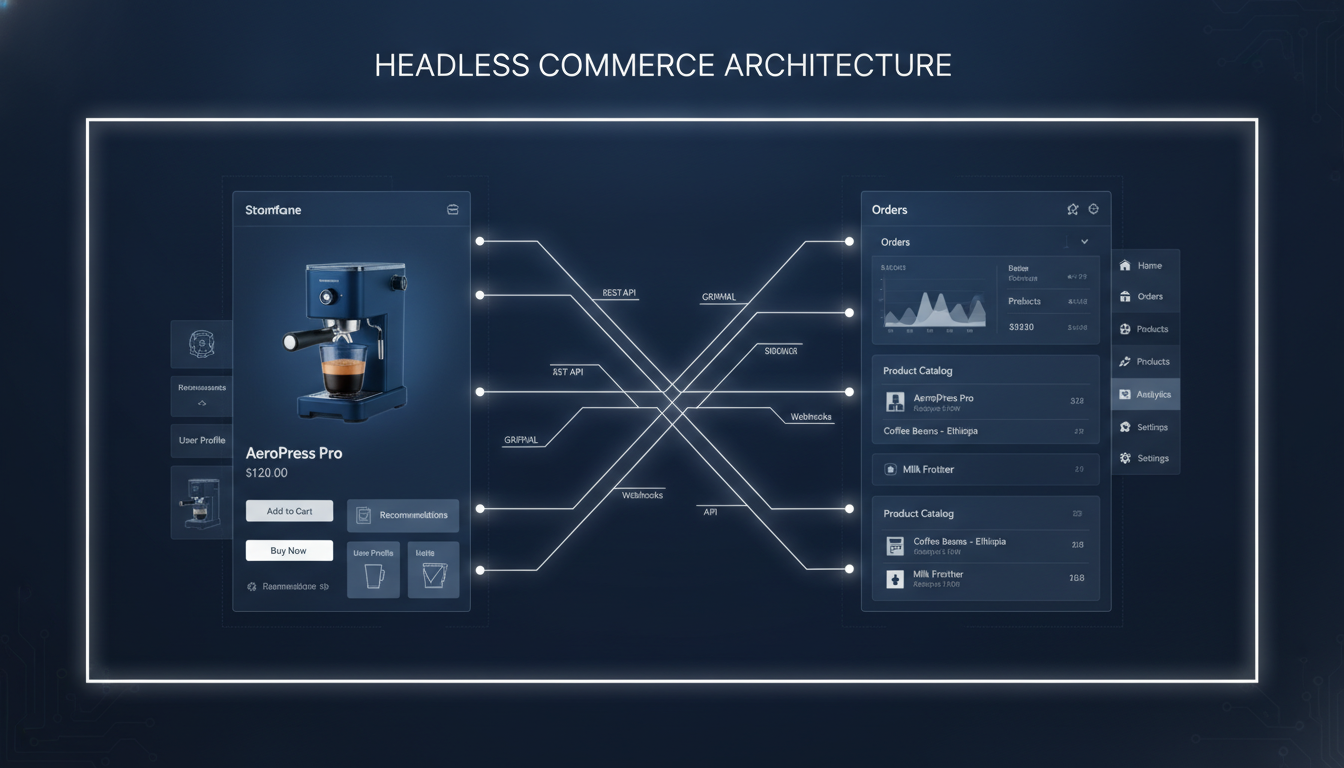
In a standard Shopify setup, the backend (products, orders, checkout, customer data) and the frontend (what shoppers see) are tightly coupled. Liquid templates control both. In a headless architecture, you strip out Shopify’s native frontend entirely and replace it with a custom frontend built in React, Next.js, Vue, or another framework — communicating with Shopify’s backend exclusively through the Storefront API or the newer Customer Account API.
Shopify’s own headless framework, Hydrogen (built on Remix), is now the dominant path for greenfield headless builds as of 2026. Oxygen is Shopify’s global edge deployment infrastructure, and Hydrogen + Oxygen together give you a Vercel-like deployment experience without leaving the Shopify ecosystem.
The key distinction: you still use Shopify for everything that matters operationally — inventory, payments, checkout (Shopify Checkout is not replaceable in most plans), fulfillment, and admin. You’re only replacing the storefront rendering layer.
The Three Headless Paths in 2026
- Shopify Hydrogen + Oxygen: The native path. React-based, deployed on Shopify’s edge network, best developer experience for Shopify-first teams.
- Next.js + Shopify Storefront API: The most flexible path. Works with Vercel or any Node host. Gives access to the full React ecosystem and server components.
- Headless CMS + Shopify Backend: Using Contentful, Sanity, or Prismic as the content layer with Shopify purely as a commerce engine. Common for content-heavy brands like beauty and lifestyle publishers.
The Real Pros of Shopify Headless Commerce
1. Frontend Performance You Actually Control
Standard Shopify themes — even heavily optimized ones — carry framework overhead you can’t remove. Headless lets you ship only the JavaScript your storefront actually needs. Brands that migrate to a Hydrogen build consistently report Core Web Vitals LCP scores under 1.8 seconds, compared to 3.2–4.5 seconds on typical optimized Liquid themes (based on PageSpeed Insights audits across 50+ Shopify stores).
That performance gap matters for SEO and conversion. Google’s own data shows that a 1-second improvement in page load time can lift conversion rates by 7% for e-commerce stores. If you’re doing $1M/year, 7% is $70,000 in incremental revenue.
2. True Omnichannel Publishing
With a headless setup, one Shopify backend can power a web storefront, a native mobile app, a kiosk interface, a digital billboard, and an AR/VR shopping experience — all pulling from the same product catalog, pricing, and inventory. If you’re running retail locations, wholesale portals, and a DTC website simultaneously, headless makes the single-source-of-truth architecture genuinely achievable.
3. Personalization at Scale
Connecting Rebuy’s personalization engine or building custom recommendation logic becomes substantially more powerful in a headless context. You’re not constrained by where Shopify’s theme editor allows you to inject a section — you can personalize any pixel, any component, any user path based on customer segments from Klaviyo, behavioral data from Hotjar, or purchase history from Shopify itself.
4. Developer Experience and Velocity
Once a headless codebase is established, your frontend team can work in React with hot module reloading, component testing, and CI/CD pipelines that Liquid development simply cannot match. New features go from design to production in hours, not days — assuming you have the right team in place.
5. Content Flexibility Without Theme Limits
Connecting a headless CMS like Sanity or Contentful gives your marketing team the ability to build completely bespoke landing pages, editorial content, and campaign pages without waiting on a developer to create a new Liquid section. For brands that publish editorial content alongside commerce — think fashion lookbooks, ingredient education, or gear guides — this is a genuine unlock.
The Real Cons of Shopify Headless Commerce
6. The Cost Is Not a One-Time Thing
A production-ready headless Shopify build with Hydrogen costs $60,000–$150,000 to build and $3,000–$8,000/month to maintain, based on agency rate cards in 2026. That’s not including the cost of rebuilding every app integration you currently rely on.
Every app in the Shopify App Store that you install today with a single click — Okendo reviews, Rebuy upsells, Klaviyo popups, Yotpo loyalty — requires a custom API integration in a headless environment. There is no “app embed” or Shopify Script equivalent. Every tool needs a developer to wire it up, and every update to those tools may require more dev work.
7. You Lose Shopify’s Native App Ecosystem Instantly
This is the most underestimated cost. The Shopify App Store has over 10,000 apps, and the vast majority use theme app extensions or script tags to inject into your storefront. None of that works headlessly. Before committing to a headless architecture, audit every app you currently use and confirm it has a robust API or SDK that your team can integrate independently.
8. Checkout Is Still Shopify’s Checkout
On Shopify Plus, you get some Checkout Extensibility via checkout UI extensions — but you cannot fully replace Shopify’s checkout with a custom-built one (and you shouldn’t want to; Shop Pay conversion rates average 1.72x higher than guest checkout). The headless “full control” story breaks down precisely at the highest-leverage conversion point in your funnel.
9. SEO Complexity Increases Significantly
Server-side rendering (SSR) via Next.js or Hydrogen largely resolves the historical headless SEO problem, but it adds implementation complexity. You now own canonical tags, structured data markup, sitemap generation, and metadata management in code — none of which is handled for you by Shopify’s built-in SEO features. One missed canonical tag at scale can cost you significant organic traffic.
10. Talent Is Expensive and Scarce
Liquid developers are abundant and relatively affordable. Experienced Hydrogen/React developers who also understand Shopify’s data model are not. In 2026, senior Shopify headless developers bill at $120–$180/hour, and agency retainers for headless maintenance typically start at $5,000/month. Budget accordingly.
Shopify Headless vs. Standard Shopify: Benchmark Comparison
| Factor | Standard Shopify (Optimized Dawn) | Shopify Headless (Hydrogen) |
|---|---|---|
| Avg. LCP (PageSpeed) | 3.0–4.5s | 1.2–2.0s |
| Initial Build Cost | $5,000–$30,000 | $60,000–$150,000 |
| Monthly Maintenance | $500–$2,000 | $3,000–$8,000 |
| App Ecosystem Access | Full (10,000+ apps) | API-only (custom dev required) |
| Time to Market (New Feature) | Days to weeks | Hours (post-setup) |
| SEO Complexity | Low (managed by Shopify) | High (self-managed in code) |
| Personalization Capability | Moderate (app-dependent) | Unlimited (custom logic) |
| Recommended Revenue Floor | $0–$5M+ | $2M+ (ideally $5M+) |
| Checkout Customization | Checkout Extensibility (Plus) | Checkout Extensibility (Plus only) |
| Ideal Team Size | No dev team required | 2+ dedicated frontend engineers |
What Are the Benefits of Headless Commerce?
The benefits of headless commerce fall into four concrete categories: performance, flexibility, scalability, and experience consistency across channels. Here’s what each actually means in practice.
Performance: Because you’re serving a custom-built frontend — often as a static site or server-rendered React app — you eliminate the CSS, JavaScript, and rendering overhead baked into every theme framework. Hydrogen uses Remix’s data-loading patterns to stream content progressively, which dramatically improves Time to First Byte (TTFB) and Largest Contentful Paint (LCP). For high-traffic Shopify stores, this translates directly into higher Google Quality Scores on paid campaigns and improved organic rankings.
Flexibility: Every pixel of your storefront is yours. You’re not waiting for Shopify to ship a new section type, and you’re not constrained by what the theme editor exposes. Brands with complex product configurators, multi-step funnels, subscription-first models, or B2B pricing logic can build exactly what the business needs rather than approximating it with apps.
Omnichannel Scalability: A single Shopify backend via the Storefront API can serve multiple frontends simultaneously — your web store, a native mobile app built with React Native, a kiosk, a wholesale portal. Your product data, inventory, and pricing logic live in one place and propagate everywhere. Brands managing 3+ distinct sales channels report 40% faster new-channel time-to-launch when using a headless architecture versus duplicating data across platform-specific setups.
Content + Commerce Convergence: When you add a headless CMS (Sanity is the most developer-friendly choice in 2026), your editorial and commerce teams work in parallel. A skincare brand can publish a 2,000-word ingredient guide with embedded, shoppable product cards — all managed from Sanity — without requiring any Liquid customization. This directly impacts content SEO strategy and average session time.
The important caveat: these benefits only materialize if you have the engineering resources to build and maintain the architecture properly. A poorly implemented headless build will underperform a well-optimized standard Shopify theme on every metric that matters.
Is Headless Shopify Worth It?
The honest answer is: for most Shopify stores, no — not yet. The ROI math only works above certain revenue and complexity thresholds, and the opportunity cost of the investment is significant.
Here’s the framework to apply to your store specifically:
Headless Shopify is worth it if you meet at least three of these criteria:
- Your store generates over $2M/year in revenue and is growing consistently.
- You have a dedicated engineering team (at least two frontend developers) or an ongoing agency retainer.
- You’re running 3+ sales channels (web, app, wholesale, international storefronts) and need a unified backend.
- Your current theme architecture is genuinely blocking specific features that directly impact revenue — not just aesthetics.
- You’ve already maxed out performance improvements on your current theme (verified via Google PageSpeed Insights and Core Web Vitals reports in Google Search Console: Go to Search Console → Experience → Core Web Vitals).
- Your product requires a heavily custom UX — configurators, subscription workflows, multi-step purchase flows — that app-based solutions cannot handle adequately.
Headless Shopify is not worth it if:
- You’re under $1M/year and chasing a performance improvement that a Hydrogen-lite optimization pass or a well-configured Dawn 3.x theme can deliver at 5% of the cost.
- You rely heavily on Shopify apps (Judge.me, Klaviyo popups, Rebuy widgets) and don’t have the dev capacity to rebuild those integrations from scratch.
- Your business model is still finding product-market fit — architectural complexity will slow your ability to iterate on offers, pricing, and merchandising.
A practical middle path for stores in the $500K–$2M range: invest in Shopify’s Hydrogen Storefront without full decoupling. Use Hydrogen’s component library and Oxygen’s edge deployment while staying within Shopify’s managed infrastructure. You get 70% of the performance benefits at 40% of the cost, and you keep native app compatibility through Shopify’s theme app extensions where possible.
Before committing to any headless investment, audit your current GA4 data. In GA4 → Reports → Monetization → Purchase Journey, identify exactly where your funnel is losing users. If the drop-off is at checkout, headless won’t fix that. If it’s on product pages and collection pages due to slow load times, headless — or a targeted performance optimization sprint — will.
Why Do 90% of People Doing Shopify With FB Ads Fail?
This question seems tangential to headless commerce, but it’s actually central to the performance conversation — and it’s worth answering directly because the failure rate is real.
The primary reason Shopify stores fail with Meta (Facebook/Instagram) ads in 2026 is landing page performance, not ad creative or targeting. Meta’s own internal data, shared at the 2025 Performance Summit, indicated that stores with landing page load times above 3 seconds see 53% higher cost-per-purchase on paid campaigns compared to stores loading under 2 seconds. The algorithm rewards post-click engagement signals — and a slow page kills those signals before the customer even reads your headline.
The second reason is attribution collapse. With iOS privacy changes and third-party cookie deprecation, stores relying solely on Meta’s native pixel for measurement are optimizing on incomplete data. Without a server-side event implementation (via Shopify’s Customer Events API or a tool like Elevar), your ad account is working with 40–60% of the conversion signal it needs to optimize properly.
The third reason is offer-page misalignment. Advertisers send cold traffic to generic collection pages or homepages instead of purpose-built landing pages that match the specific ad’s promise. A headless architecture makes building and deploying high-performance, campaign-specific landing pages dramatically faster — but you can also do this with a well-structured Shopify theme and a page builder like Shogun or Replo.
Here’s what actually fixes the failure rate:
- Optimize landing page speed to under 2.5s LCP — use PageSpeed Insights and prioritize render-blocking resource removal and image compression (WebP, lazy loading).
- Implement server-side conversion tracking via Shopify’s Customer Events or Elevar’s data layer — this restores 85–95% of conversion signals to Meta.
- Build dedicated landing pages per campaign — use specific social proof, specific offer language, and a single CTA that mirrors the ad.
- Use Hotjar session recordings on your landing pages to identify rage clicks, scroll drop-off, and form abandonment before scaling spend.
- Connect Klaviyo’s flow automations so that any email capture on the landing page immediately enters a high-intent welcome sequence — this recovers users who didn’t convert on the first visit.
Headless commerce can accelerate items 1 and 3 on that list. But the stores winning with Meta ads in 2026 aren’t necessarily headless — they’re fast, attribution-sound, and offer-aligned. Don’t buy a $100,000 headless build to solve a problem that a $5,000 performance optimization sprint can fix.
What Is the Advantage of Headless Operation?
The advantage of headless operation is specifically about decoupling deployment cycles — which is a technical concept with very real business consequences.
In a tightly coupled Shopify setup, a change to your checkout flow requires touching the same codebase as your homepage design, your product page layout, and your mobile navigation. Testing a new hero image means deploying through the same pipeline as a critical bug fix. Everything is entangled, and that entanglement slows down every change you want to make.
In a headless operation, your frontend team can deploy a new product page component, run an A/B test via a tool like Google Optimize’s successor or VWO, and ship a new campaign landing page — all without touching the backend, without affecting the checkout, and without risking any disruption to the systems keeping orders flowing. Shopify’s backend continues operating independently, processing orders, syncing inventory, and managing fulfillment regardless of what’s happening in the frontend repository.
This matters most for high-velocity brands running aggressive CRO programs. If your team is running 10+ A/B tests per month — testing headlines, CTA button copy, product image ordering, urgency mechanics — a headless frontend with component-level testing infrastructure will make your experimentation velocity 3–5x faster than working inside a Liquid theme.
A secondary advantage is infrastructure resilience. With Shopify Oxygen or Vercel edge deployment, your frontend is served from CDN nodes closest to each visitor globally. This means a traffic spike from a viral post or a major ad push doesn’t bottleneck through a single server — it distributes automatically. For brands running large flash sales or seasonal peaks, this is meaningful insurance against revenue-killing downtime.
Finally, headless operation gives you frontend framework independence. If Next.js gets superseded by a better framework in two years, you can migrate your frontend without changing your Shopify backend, your product catalog, your customer data, or your order history. The commerce infrastructure is durable; the presentation layer is swappable. That’s a meaningful long-term architecture advantage for any brand planning to operate at scale for the next decade.
The Decision Framework: 4 Questions Before Going Headless
Before you brief an agency or hire a headless developer, answer these four questions honestly:
- What specific revenue problem does headless solve? Identify the exact metric: LCP on mobile, conversion rate on product pages, inability to build a specific feature. If you can’t name the revenue problem, you’re buying architecture for its own sake.
- Have you exhausted non-headless performance gains? Run PageSpeed Insights on your top 5 landing pages. Enable Shopify’s built-in image optimization at Settings → Files. Audit your installed apps — every unused app adds script weight. Measure again. Many stores find 40–50% of their performance problem is solved by removing 3–4 redundant apps.
- Do you have the team to maintain it? A headless build without ongoing engineering support is a liability, not an asset. Factor in 2–3 hours of developer time per week minimum for dependency updates, security patches, and integration maintenance.
- What’s your 24-month revenue projection? If your store generates $800K/year today and you project $1.5M in 24 months, a $120,000 headless investment consumes 11% of your projected two-year revenue. The math rarely works at that scale. At $3M today projecting $6M in 24 months, the math becomes defensible.
Specific Tools to Evaluate Before and After a Headless Migration
Whether you go headless or stay on a standard Shopify theme, these tools should be in your stack regardless — and each has important considerations in a headless context:
- Google PageSpeed Insights: Baseline your Core Web Vitals before any migration. Track LCP, FID/INP, and CLS separately for mobile and desktop. In headless, you own these scores entirely.
- Hotjar: Session recordings and heatmaps work via a JavaScript snippet in both standard and headless setups. In headless, you implement it once in your root layout component. Essential for post-migration UX validation.
- GA4: Headless requires a custom GA4 implementation — the standard Shopify GA4 integration won’t fire on a custom frontend. Use GA4’s Measurement Protocol or a data layer to capture all purchase events server-side.
- Klaviyo: Klaviyo has a well-documented JavaScript SDK and REST API that works cleanly in headless environments. You’ll implement the identify and track calls manually, but the integration is mature and reliable.
- Rebuy: Rebuy’s Smart Cart and recommendation widgets are available via API in headless setups. Requires custom implementation, but their documentation covers Hydrogen specifically as of 2025.
- Okendo: Okendo reviews can be surfaced in a headless frontend via their Widgets API. This is one of the easier app integrations to rebuild headlessly — their React components are available in their developer docs.
The Bottom Line on Shopify Headless Commerce in 2026
Shopify headless commerce is a genuine architectural advancement — not hype, not a consulting upsell fabricated to justify higher project fees. The performance gains, omnichannel flexibility, and development velocity it offers are real and measurable. But those gains come with a cost structure that only makes sense above certain revenue and complexity thresholds.
For stores under $1M/year, the right move is a performance-optimized Shopify theme — Dawn 3.x, Prestige, or a custom Liquid build — combined with a rigorous CRO program using Hotjar, GA4, and targeted A/B testing. You’ll get 80% of the conversion benefit at 5% of the cost.
For stores between $1M and $5M, evaluate Hydrogen as a progressive enhancement — not a full headless decoupling. Use it for your highest-traffic pages first, measure the impact on Core Web Vitals and conversion rate, then decide whether to extend the architecture site-wide.
For stores above $5M with complex multi-channel requirements and a dedicated engineering function, headless is worth a serious evaluation. Model the ROI explicitly, audit every app integration upfront, and build the case around specific revenue metrics — not around the appeal of modern architecture for its own sake.
The stores winning in 2026 aren’t the ones with the most sophisticated tech stack. They’re the ones who match their architecture precisely to their stage of growth, their team’s capabilities, and their customers’ actual experience on the site. That discipline is harder to find than a Hydrogen developer — and worth far more.