
Shopify Mobile App Builder Comparison: 7 Best Platforms & Tools (2026)
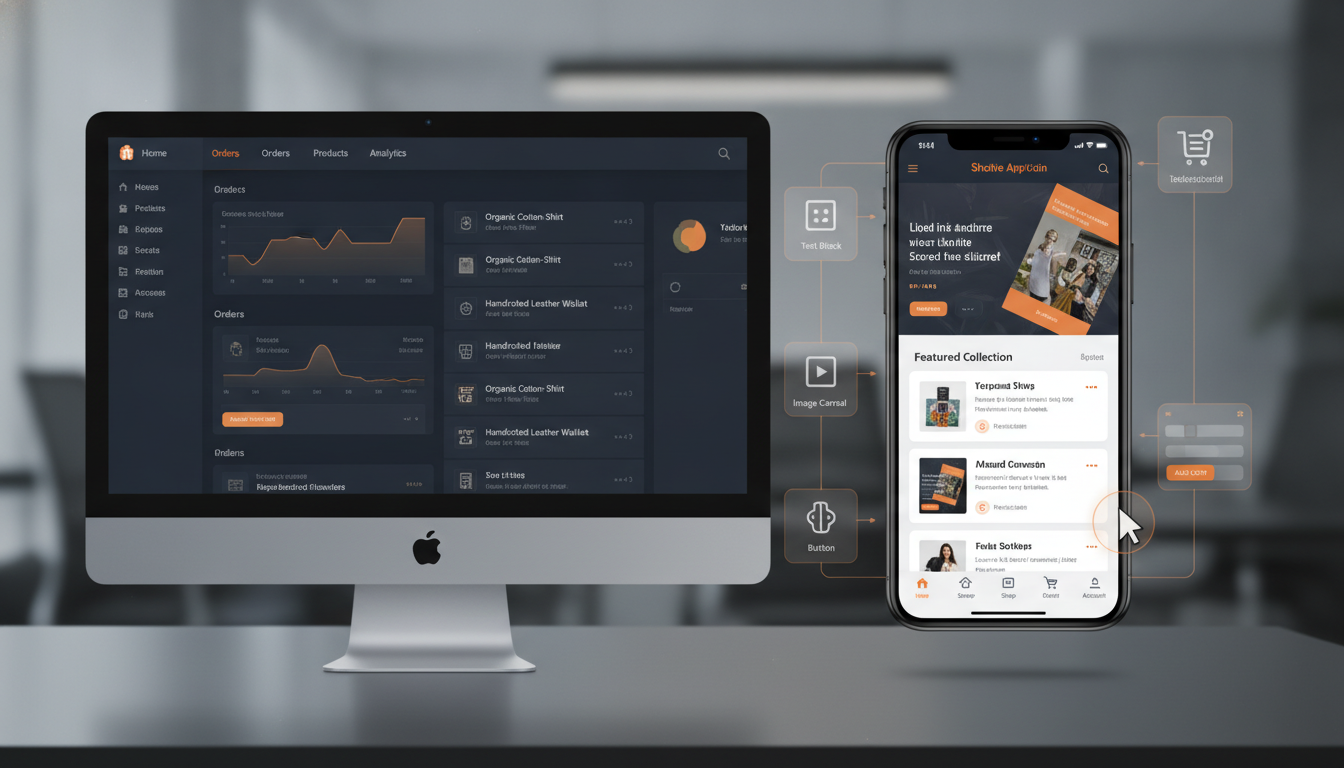
Your Shopify store’s mobile traffic is almost certainly outpacing desktop — and yet mobile conversion rates average just 1.53% compared to 4.14% on desktop (Statista, 2025). That gap exists largely because a mobile browser is not a mobile app. Push notifications, native gestures, biometric checkout, and offline browsing all require a dedicated app experience that a responsive theme alone cannot replicate.
Choosing the wrong Shopify mobile app builder — or skipping the decision entirely — means handing revenue to competitors who already have icon space on your customers’ home screens. This guide breaks down exactly which builder fits which business stage, what custom Shopify mobile app development costs in 2026, and which platforms are quietly eating into Shopify’s native ecosystem.
- No-code Shopify mobile app builders like Vajro and Tapcart can launch an iOS/Android app in under two weeks — but they carry monthly fees of $99–$999.
- Custom Shopify mobile app development delivers deeper integrations and full ownership but costs $15,000–$80,000+ depending on scope and location.
- Push notifications alone — a core feature of every app builder — drive an average 9.6% direct open rate versus 1–3% for email (OneSignal, 2025).
- Builders like Plobal Apps and MageNative include AI-driven personalization engines that rival what previously required custom dev work.
- The right choice depends on your GMV, tech stack complexity, and how much of your customer base already shops on mobile.
Why Shopify Store Owners Are Prioritising Mobile Apps in 2026
Mobile commerce will account for 62% of all global e-commerce sales in 2026 (eMarketer). Shopify’s own data shows that stores with branded native apps see average order values 20–30% higher than mobile web sessions, largely because of frictionless checkout and loyalty mechanics baked into the app experience.
The calculation shifts fast once you account for customer acquisition costs. Paid social CPMs have risen 28% year-over-year since 2023 (Meta Business Insights). A home-screen icon is essentially free, recurring ad space — and push notifications give you a direct line to customers that no algorithm can throttle.
The question is never whether to build an app. It’s how — and that answer depends entirely on your situation.
Shopify Mobile App Builder vs Custom Development: The Real Trade-offs
This is the decision that splits most merchants. No-code builders get you live quickly, but they all share a structural limitation: you’re building on someone else’s infrastructure. Your app lives inside their ecosystem, and if they raise prices, sunset features, or get acquired, you feel that pain immediately.
Custom Shopify mobile app development — whether built in-house, through an agency, or through custom Shopify mobile app development partners in India or Eastern Europe — gives you full ownership of the codebase, the ability to integrate proprietary data sources, and the flexibility to build mechanics no builder supports out of the box.
Cost and Timeline Comparison
| Approach | Typical Cost | Time to Launch | Ongoing Monthly Cost | Best For |
|---|---|---|---|---|
| No-code Builder (Vajro, Tapcart) | $0 setup + subscription | 1–2 weeks | $99–$999/mo | $50K–$500K GMV stores |
| Mid-tier Builder (Plobal, MageNative) | $0–$500 setup | 2–4 weeks | $149–$799/mo | $200K–$1M GMV stores |
| Custom Dev — India Agency | $15,000–$35,000 | 3–5 months | $500–$2,000/mo (maintenance) | $500K+ GMV, complex integrations |
| Custom Dev — US/UK Agency | $50,000–$150,000+ | 4–8 months | $2,000–$8,000/mo (maintenance) | $2M+ GMV, enterprise requirements |
| PWA (Progressive Web App) | $5,000–$25,000 | 6–12 weeks | Hosting costs only | Budget-conscious stores, SEO priority |
The break-even math is straightforward: if a builder costs $399/month and you’re generating $300K/year in revenue, that’s 1.6% of revenue for infrastructure. Once you cross $1M GMV, custom development typically pays for itself within 12–18 months through eliminated subscription fees and conversion improvements from a fully native experience.
The 7 Best Shopify Mobile App Builders Compared (2026)
1. Vajro
Vajro is the most widely cited Shopify mobile app builder in the Shopify App Store and currently serves over 5,000 merchants globally. Its drag-and-drop interface lets you replicate your existing Shopify store layout with zero code, and the platform syncs products, collections, and discounts in real time via the Shopify API.
The standout feature in 2026 is Vajro’s Live Video Shopping integration, which lets you broadcast live to app users and tag products mid-stream — a mechanic that has delivered 4–6x higher conversion rates than static PDPs for fashion and beauty brands (Vajro internal data, 2025).
- Pricing: Starter at $99/month, Growth at $299/month, Power at $599/month
- Push notifications: Unlimited on Growth and above
- Shopify Plus compatible: Yes
- Klaviyo integration: Native, two-way sync available on Growth plan
- Best for: DTC brands in fashion, beauty, and lifestyle with an engaged community
One real limitation: Vajro’s checkout experience is built on Shopify’s web checkout rendered inside the app, not a fully native checkout flow. That means you don’t get true biometric authentication (Face ID, Touch ID) at the payment step — a friction point that custom apps eliminate.
2. Tapcart
Tapcart targets higher-revenue Shopify merchants and is the preferred builder for brands doing $1M+ in annual revenue. Its core differentiator is Custom Blocks — a feature that lets Shopify developers inject custom Liquid-like components into the app’s UI without leaving the Tapcart ecosystem.
Tapcart also has the deepest native integration with Klaviyo of any builder on this list, allowing behavioral segmentation from email flows to power in-app push notification triggers. If a customer abandons their cart in the app, you can fire a Klaviyo-triggered push within minutes, not hours.
- Pricing: Core at $200/month, Ultimate at $400/month, Enterprise (custom)
- Shopify Plus compatible: Yes, with Shopify Functions support
- Analytics: Native GA4 and Amplitude integrations
- Best for: Scaling DTC brands that already use Klaviyo and want tight CRM-to-app connectivity
3. Plobal Apps
Plobal positions itself as an AI-first mobile app builder for Shopify, and in 2026, that positioning is more substantive than marketing. Its AI Merchandising Engine dynamically reorders product collections based on individual user behavior within the app — similar to what Rebuy does for web personalization, but applied natively inside the mobile experience.
Plobal also includes automated smart banners, an in-app loyalty program module, and deep-linking capabilities that allow paid social ads to open directly to specific product pages inside the app rather than the browser.
- Pricing: Growth at $149/month, Scale at $349/month, Enterprise (custom)
- AI personalization: Available on Scale plan and above
- Best for: Stores with large catalogs where smart merchandising drives conversion
4. MageNative
MageNative is the strongest option if cost efficiency is a priority. It offers a free plan for merchants who want to test mobile app performance before committing, though the free tier is limited to 500 push notification subscribers and basic templates. Its paid plans start at $49/month — significantly below Vajro and Tapcart.
The platform integrates natively with Shopify’s product reviews ecosystem and supports Okendo and Judge.me review displays inside the app, which matters because 93% of consumers read reviews before purchasing (BrightLocal, 2025). If your Shopify store runs heavy on social proof, MageNative preserves that mechanic cleanly.
- Pricing: Free (limited), Basic at $49/month, Standard at $99/month, Enterprise at $199/month
- Best for: Sub-$500K GMV stores validating mobile app ROI before full investment
5. Shopney
Shopney focuses specifically on converting high-intent visitors into repeat buyers through in-app messaging and chat. Every Shopney app ships with a built-in live chat module that connects to your existing help desk (Gorgias, Tidio, or Zendesk) without requiring separate SDK installation.
For brands where customer service drives repeat purchases — subscription boxes, custom products, high-consideration purchases — this differentiation is meaningful. Shopney also has the best multilingual support of any builder, handling RTL languages including Arabic and Hebrew natively.
- Pricing: Bronze at $149/month, Silver at $249/month, Gold at $499/month, Platinum at $999/month
- Best for: International merchants and brands with high customer service volume
6. Flits (App for Customer Accounts)
Flits occupies a different niche — it’s not a full app builder, but a Shopify app that transforms your customer account portal into an app-like experience with wishlist, store credits, and referral features. It’s worth including here because many merchants don’t need a standalone iOS/Android app — they need a better logged-in experience that drives repeat purchases.
- Pricing: From $19/month
- Best for: Subscription-heavy stores or loyalty-first brands who want app-like retention without App Store submission overhead
7. Custom Development (React Native / Flutter)
For stores doing $1M+ GMV with complex requirements — custom ERP integrations, proprietary recommendation engines, or B2B ordering logic — no builder will do the job. A custom Shopify mobile app built in React Native or Flutter gives you a single codebase that compiles to native iOS and Android, with full access to Shopify’s Storefront API and Customer Account API.
Custom Shopify mobile app development agencies in India (Bengaluru, Pune, and Hyderabad are strong clusters) typically deliver React Native apps at $15,000–$35,000, while US-based boutique agencies like those in the Shopify Plus Partner network charge $60,000–$150,000 for similar scope. The quality gap is narrower in 2026 than it was three years ago, largely because of standardized Shopify API tooling.
How to Set Up a Mobile App Builder on Shopify: Step-by-Step
Using Vajro as the reference example — the process is nearly identical for Tapcart, Plobal, and MageNative:
- Log in to your Shopify Admin and navigate to Apps → Shopify App Store.
- Search for your chosen builder (e.g., “Vajro”) and click Add app. Approve the required API permissions — product read, order read, customer read, and script injection access are standard.
- Inside the builder dashboard, select your theme template and map your existing Shopify collections to app navigation sections.
- Configure push notification opt-in copy and timing (best practice: trigger the opt-in prompt after the user has viewed 3+ products, not on first launch — this improves opt-in rates by ~40% per OneSignal benchmarks).
- Connect your Klaviyo account via Settings → Integrations → Klaviyo inside the builder dashboard, then map your Klaviyo list IDs to the app subscriber segments.
- Set up your Apple Developer Account ($99/year) and Google Play Developer Account ($25 one-time) if you don’t already have them — the builder will walk you through provisioning profiles and signing certificates.
- Submit to the App Store and Google Play. Apple review averages 1–3 days in 2026; Google Play averages 24–48 hours for initial submissions.
- Post-launch, connect GA4 to your app via the builder’s analytics integration. Navigate to GA4 → Admin → Data Streams → Add Stream → iOS/Android app and paste the tracking ID provided by the builder.
Can I Build a Mobile App with Shopify?
Yes — and you have three distinct routes to do it. Shopify does not natively ship with an iOS or Android app builder for merchants, but the Shopify ecosystem supports mobile app creation through third-party builders (like Vajro, Tapcart, and Plobal), through custom development using Shopify’s Storefront API, or through Progressive Web App (PWA) implementations that behave like native apps on modern devices.
The Shopify Storefront API is the backbone of any custom mobile app. It gives developers read/write access to products, collections, carts, checkouts, and customer accounts via GraphQL — the same technology powering headless Shopify storefronts. When a developer builds a React Native or Flutter app for your Shopify store, they’re essentially building a custom frontend that talks to Shopify’s backend through this API.
For merchants who want to validate the channel before investing in custom development, no-code builders are a legitimate starting point. Vajro claims its merchant base sees an average 4x ROI within 90 days of app launch — a figure you should treat with appropriate skepticism, but the direction is directionally consistent with independent studies showing native apps drive higher session frequency and repeat purchase rates than mobile web.
One critical distinction: a Shopify mobile app is different from the Shopify mobile app that Shopify itself provides to merchants for managing orders. The former is a customer-facing shopping app; the latter is an admin tool. When evaluating any builder, confirm it produces a customer-facing app submitted to the Apple App Store and Google Play Store under your brand name — not a white-label subdomain experience.
PWAs are worth mentioning separately. A PWA built on your Shopify store (using tools like Builder.io or custom Next.js development) can be added to a user’s home screen without App Store approval. However, PWAs cannot send push notifications on iOS Safari until iOS 16.4+, and they still lack access to certain native device APIs. For most merchants, a native app via a builder or custom development is the stronger long-term choice.
Does Shopify Work with Shein?
This is a question that surfaces frequently but conflates two very different business models. Shopify does not have a direct integration or official partnership with Shein as of 2026. Shein operates its own proprietary marketplace and supply chain platform — it is not a Shopify merchant, a Shopify sales channel, or a fulfillment partner available through the Shopify App Store.
What you can do is sell on multiple channels simultaneously using Shopify as your central commerce hub. Shopify natively connects to Amazon, eBay, TikTok Shop, Instagram, Facebook, Google Shopping, and Walmart Marketplace through built-in Sales Channels (navigate to Shopify Admin → Sales Channels → Add sales channel). Shein is not on that list.
If you’re asking because you want to dropship Shein-sourced products through your Shopify store, that’s a legally and ethically fraught territory. Shein’s terms of service prohibit reselling their products without authorization, and many of their products carry unresolved intellectual property disputes with major fashion brands. The practical and legal risks significantly outweigh the margin opportunity.
The underlying question is usually about competing with Shein on price — a race almost no Shopify merchant should enter. Shein’s average order value is under $30, subsidized by Chinese government export incentives that are now being actively challenged by US trade policy including the elimination of the de minimis exemption in 2025. Independent Shopify brands compete most effectively against Shein by going in the exact opposite direction: higher quality, transparent supply chains, community engagement, and app-based loyalty programs that Shein’s anonymous marketplace model cannot replicate.
If competitive pressure from ultra-low-cost marketplaces is a concern for your business, investing in a Shopify mobile app with a loyalty and subscription module is a more strategic response than attempting a price war.
Will AI Replace Shopify Developers?
Not entirely — but the role is changing at speed, and merchants need to understand what that means for their development budgets. GitHub Copilot users report 55% faster code completion on routine tasks (GitHub, 2025), and tools like Cursor AI and Replit Agent can scaffold a functional Shopify Liquid theme section in minutes that would have taken a junior developer an hour in 2022.
For Shopify specifically, AI is already replacing certain categories of work entirely:
- Basic Liquid customization — Adding metafields, modifying section schemas, and building simple conditional display logic is now largely AI-assisted and commoditized.
- Shopify app boilerplate — Spinning up a Shopify app with authentication, webhook handling, and billing using the Shopify CLI and AI pair programming is now a one-day task, not a two-week sprint.
- Theme store customization — Adjusting existing Dawn or Sense theme templates for brand-specific requirements is increasingly handled by non-developers using AI prompting tools like Replo or Shogun’s AI features.
What AI cannot replace — at least not through 2027 — is systems-level judgment. Deciding whether your Shopify store should go headless, which third-party apps create performance conflicts with your theme, how to architect a multi-region Shopify Markets setup with custom pricing logic, or when to use Shopify Functions versus a custom app — these decisions require contextual expertise that large language models currently hallucinate on with alarming frequency.
For mobile app development specifically, AI accelerates the build but doesn’t own the architecture. A custom Shopify mobile app that integrates Klaviyo behavioral data, Rebuy recommendations, and a custom loyalty ledger requires a developer who understands all three systems deeply — AI helps write the code, but a human still needs to spec and review it.
The practical takeaway for Shopify merchants: junior development work is getting cheaper and faster because of AI. Senior strategic development is becoming more valuable, not less, because the bar for what’s technically possible has risen and someone still needs to decide what to build and why.
Can You Make $10K a Month on Shopify?
Yes — and it happens regularly, but not automatically. Shopify reported over 65,000 merchants generating more than $100,000 in annual revenue (approximately $8,300/month) through the platform as of its 2025 annual report. That’s $10K/month within reach for a meaningful segment of active stores, but “having a Shopify store” is not the mechanism — marketing, product-market fit, and operational execution are.
Here’s what the path to $10K/month actually looks like for most merchants who get there:
- Product margin discipline first. At $10K revenue, if your gross margin is below 40%, you will not sustain the business after ad spend, Shopify fees, apps, and fulfillment. The merchants who reach this milestone consistently have margins of 55–70% or are in a niche where subscription revenue creates predictable monthly recurring revenue.
- A specific acquisition channel that’s working. Almost every $10K/month Shopify store got there by mastering one channel first — Meta Ads, TikTok Shop, organic SEO, or influencer affiliate — before diversifying. Trying to be everywhere with a $5K ad budget produces mediocre results everywhere.
- Email and SMS automation from day one. Klaviyo’s benchmark data shows that stores using all five core automated flows (welcome, abandoned cart, browse abandonment, post-purchase, winback) generate 30–45% of total revenue from email alone. This is non-negotiable — set these up before you scale ad spend.
- Conversion rate optimization before scale. Use Hotjar to record sessions and identify friction points. Use PageSpeed Insights to keep your Shopify theme’s LCP under 2.5 seconds. Getting from a 1.8% to a 2.8% conversion rate effectively gives you 55% more revenue from the same traffic — no additional ad spend required.
- A mobile app or strong mobile experience. At $10K/month, you’re generating enough revenue to justify a mid-tier builder like MageNative or Plobal. The repeat purchase rate lift from push notifications alone can add 15–25% to monthly revenue once your app reaches 1,000+ subscribers.
The merchants who plateau below $10K/month are almost always underinvesting in one of two areas: customer retention (low repeat purchase rate, no loyalty mechanics) or conversion rate (driving traffic to a store that converts at under 1.5%). Both problems are solvable with existing Shopify tools — they require attention, not more ad budget.
How to Choose the Right Shopify Mobile App Builder for Your Store
Run through this decision framework before signing up for any platform:
Step 1 — Confirm Your GMV Threshold
If you’re under $200K annual revenue, start with MageNative’s free or $49/month plan. The goal at this stage is validating that your customer base engages with a mobile app — not building the perfect one. If you’re between $200K and $1M, Vajro’s Growth plan or Plobal’s Scale plan is the right level of investment. Above $1M, evaluate Tapcart Enterprise or custom development seriously.
Step 2 — Audit Your Existing Tech Stack
List every app currently installed in your Shopify Admin (navigate to Apps → Installed apps). The builder you choose must integrate natively with your retention tools — specifically your Klaviyo account, your review platform (Okendo or Judge.me), and your loyalty program (Smile.io, LoyaltyLion, or Yotpo). A builder that requires you to abandon your email automation stack to use its proprietary tools is not a good trade.
Step 3 — Evaluate Push Notification Deliverability
Ask every builder for their average push notification open rate across their merchant base. Industry average is 9.6% (OneSignal, 2025). Any builder quoting below 6% has a deliverability or UX problem. Ask specifically how they handle iOS opt-in prompting — this single design decision determines whether 20% or 60% of your app users become reachable via push.
Step 4 — Confirm App Store Ownership
Your app must be submitted under your Apple Developer account and your Google Play account — not the builder’s. If the builder hosts your app under a shared account or a white-label umbrella, you cannot migrate to another platform or custom development without losing your app’s reviews, download history, and ranking in App Store search.
The Verdict: Shopify Mobile App Builder or Custom Development in 2026?
For the majority of Shopify merchants doing $50K–$1M annually, a quality no-code builder is the correct decision — not as a compromise, but as the genuinely optimal allocation of capital and time. Vajro and Tapcart have matured to a point where the experience gap between their output and a custom-built app is narrow for standard DTC use cases. The $300–$500/month subscription cost is recovered within weeks if push notifications are activated and configured properly.
Custom Shopify mobile app development earns its price tag above the $1M GMV threshold, when your requirements include proprietary data integrations, B2B ordering logic, or subscription models too complex for builder templates. Custom Shopify mobile app development agencies in India offer a compelling cost-to-quality ratio for merchants who need custom without enterprise pricing — but vet rigorously for Shopify Storefront API experience specifically, not just general React Native capability.
Whatever route you choose, the strategic imperative is the same: your Shopify store needs a mobile app presence in 2026 — not because it’s technically interesting, but because the brands winning customer loyalty are the ones with icon space on the home screen, direct push notification access, and frictionless reorder flows that no mobile browser can match.